Walk past your kitchen bin at the end of a Sunday night and you'll see the fastest way to reduce food waste in a restaurant sitting right there: half a hotel pan of prepped garnish, three portions of a special that didn't sell, a case of herbs that wilted before anyone touched them. None of it got eaten. All of it got paid for.
Here's the direct answer: most restaurants waste a widely cited industry range of 4 to 10 percent of everything they buy, and you cut that by tracking waste for one week, then attacking the three or four biggest sources with par levels, FIFO rotation, prep-to-forecast, and tighter portioning. You do not need to buy cheaper ingredients or shrink plates. Waste lives in over-prep, spoilage, sloppy trim, and over-portioning, not in the quality of what reaches the table.
Where restaurant food waste actually hides
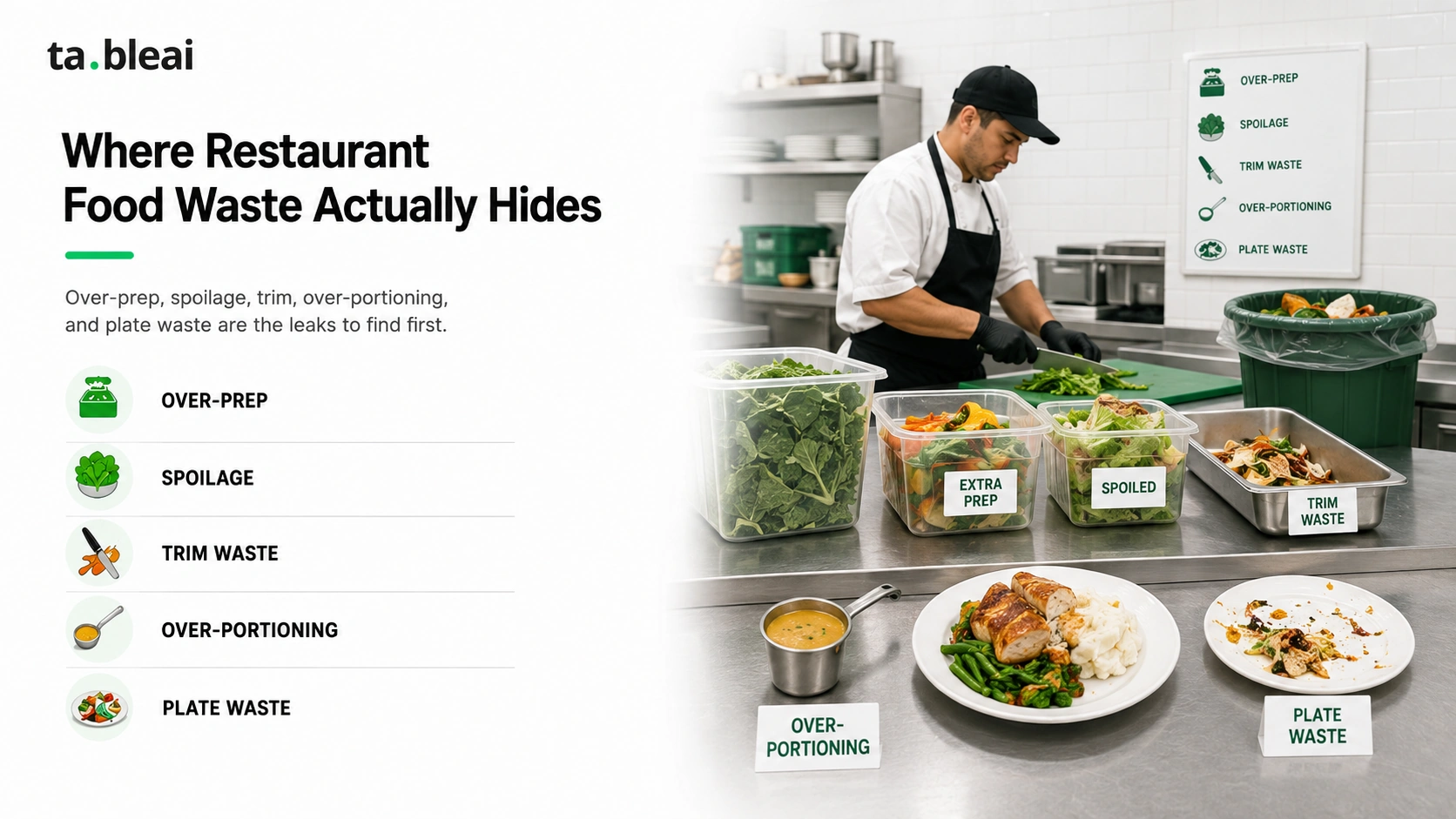
Waste is rarely one dramatic event. It's a slow leak from five taps, and most owners can't tell you which tap is worst because nobody's watching the bin.
- Over-prep. The kitchen preps for a Friday that never shows up. Whatever got cut, portioned, or par-cooked and didn't sell hits the bin two or three days later. This is usually the single biggest source.
- Spoilage. Product dies in the walk-in before it's used. Wrong rotation, over-ordering, or a delivery you forgot you had. Fresh herbs, dairy, and seafood are the usual suspects.
- Trim waste. Vegetable peels, meat trim, broccoli stems, bread ends. Some of it is genuinely unusable. A lot of it should have gone into stock, staff meal, or a soup and didn't.
- Over-portioning. Every plate that goes out with an extra ounce of protein is waste you can't even see, because it left through the dining room instead of the bin. It still costs you.
- Plate waste. Food that comes back uneaten. Sometimes that's the customer. Sometimes it's a portion so big nobody finishes it, which means you're literally paying to overfeed people.
The pattern: most of this waste has nothing to do with ingredient quality. You could buy the best produce in the world and still throw away 10 percent of it through bad rotation and hopeful prep.
Track your waste for one week before you change anything
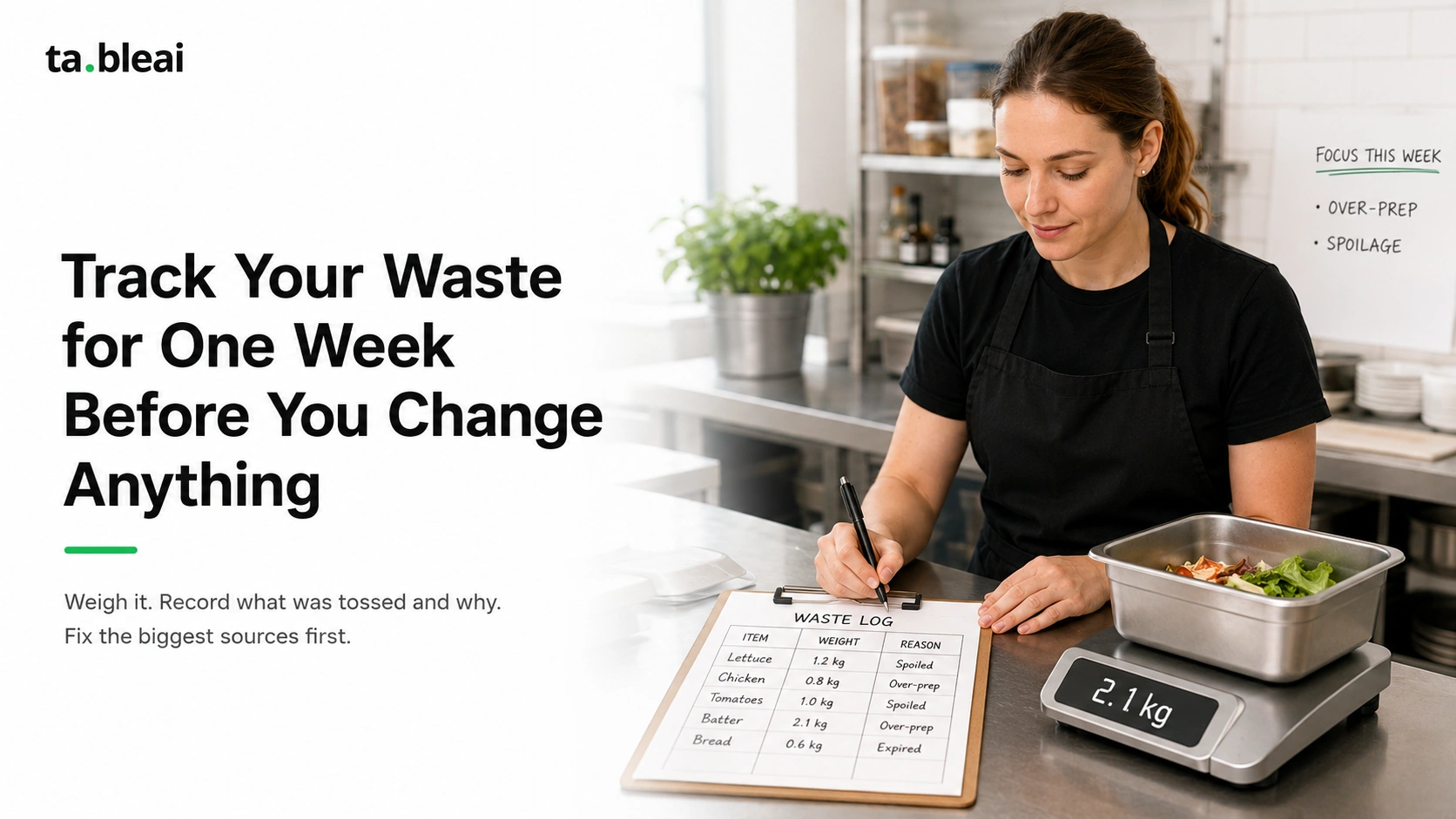
You can't fix a number you've never measured. Before you touch par levels or portions, spend one week finding out where the money actually goes.
Put a bin on a cheap kitchen scale near the pass. For seven days, everyone who throws food away writes three things on a clipboard taped to the wall: what it was, roughly how much it weighed, and why it got tossed. Prepped-and-unsold, spoiled, trim, returned plate. That's it. No fancy system.
Here's what one week of tracking might look like — these are illustrative numbers, not a benchmark:
| Category | Weekly weight | Rough cost | Share |
|---|---|---|---|
| Over-prep (unsold) | 42 lb | $310 | 44% |
| Spoilage | 26 lb | $180 | 26% |
| Trim | 30 lb | $95 | 14% |
| Plate waste | 22 lb | $110 | 16% |
| Total | 120 lb | $695 | 100% |
In this example, that's roughly $2,780 a month walking out the back door, and it shows how the picture reads once you have real numbers: here, two thirds of it is over-prep and spoilage. You don't need to fix all five sources. You need to fix the top two.
Honesty is the whole game here. If the crew quietly stops logging the embarrassing stuff, you get a clean-looking sheet and a full bin. Tell them plainly: this is about finding waste, not blaming people. Nobody's in trouble for writing down a tray of burnt rice.
What food waste is really costing you
Waste doesn't show up as a line item on any report, which is exactly why it survives. It hides inside your food cost percentage.
Every dollar of food you throw away is a dollar you spent that produced zero revenue. So waste directly inflates the number that decides whether you're profitable. Here's the link:
Food cost % (purchases basis) = (Food Purchases ÷ Food Revenue) × 100

Waste cost = Total Purchases × Waste %
Run the numbers. Say you buy $30,000 of food a month and you're wasting a typical 8 percent:
Waste cost = $30,000 × 0.08 = $2,400 per month
                            = $28,800 per year
Cut that waste from 8 percent to 4 percent and you save $1,200 a month. On a kitchen doing $30,000 in purchases, that's roughly a full point or two off your food cost percentage, and it drops straight to profit because you didn't spend a cent more on anything. No new equipment, no menu changes, no price hike your regulars will notice.
If you're not sure what your food cost percentage even is right now, start with the restaurant food cost calculator guide, then come back here to attack the waste that's inflating it.
Fixes that cut waste without touching quality
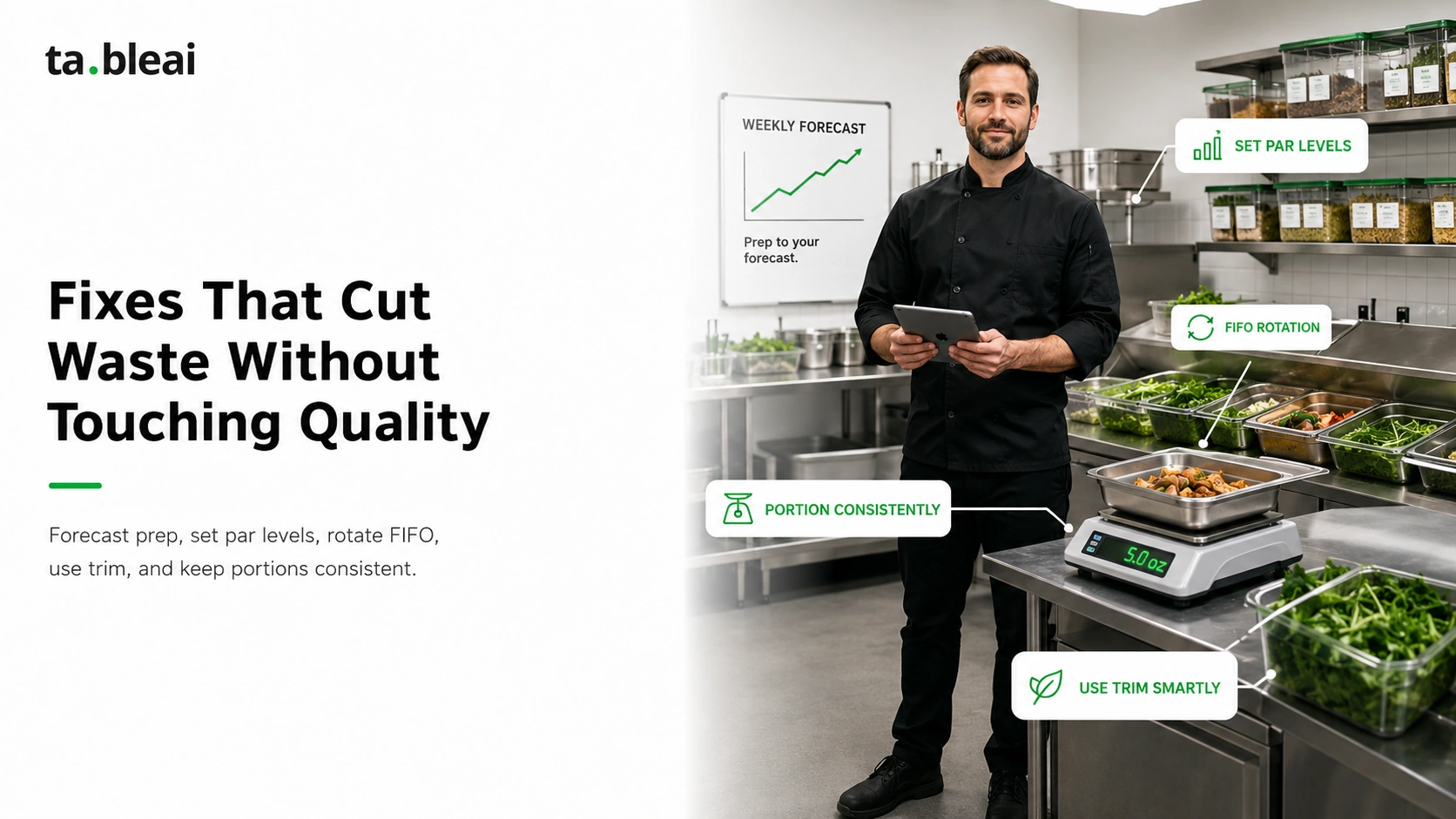
Once you know your biggest sources, the fixes are specific. None of these involve buying worse product or shrinking what the customer sees.
Set par levels so you stop over-prepping
A par level is the maximum you prep or stock for a given day, based on what you actually sell, not what you hope to sell. If you sell 40 portions of a sauce on a normal Tuesday, your Tuesday par is 45, not "make a big batch and see."
The tell for missing pars is a walk-in full of half-used prep and a bin full of it three days later. Build pars off your real sales history, one day of the week at a time, because your Saturday and your Monday are different restaurants.
Fix: For your top 15 prepped items, write a par for each day of the week. Prep to par. Adjust monthly as sales shift.
Prep to a forecast, not to a feeling
Over-prep is the number one waste source in most kitchens, and it comes from prepping the same amount every day regardless of what's coming. A quiet Monday gets the same prep as a busy Friday, and Monday's extra dies in the walk-in.
Look at what actually happens on each weekday. If Mondays average 60 covers and Fridays average 140, they should not get the same prep list. Weather, holidays, and local events swing it further.
Fix: Prep against yesterday's numbers and last week's same-day pattern. If you send a quick morning summary or track your daily sales without a POS, you can prep to a forecast in about five minutes instead of guessing.
Rotate with FIFO so nothing dies in the walk-in
FIFO means first in, first out. The product that arrived first gets used first. It sounds obvious, and it's the single most-ignored rule in every walk-in with a spoilage problem.
Newer deliveries get stacked in front of older ones, the old stuff gets buried, and two weeks later you're throwing out a case you forgot you had. That's not a quality problem. That's a shelving problem.
Fix: Date every item on arrival. Store new behind old, physically. Assign one person per shift to pull anything approaching its date to the front. A tight inventory routine for a small restaurant makes FIFO automatic instead of a constant fight.
Control portions so plates stay consistent
Over-portioning is invisible waste. An extra ounce of protein on every plate doesn't hit the bin, so you never see it, but it quietly pushes your food cost up and trains guests to expect a portion you can't afford.
Portion control is not about serving less than the menu promises. It's about serving exactly what the recipe specs, every single time, so the plate is consistent and costed correctly.
Fix: Scale and portion your proteins and high-cost items. Use the same ladle, the same scoop, the same pan. Spot-check three plates mid-service once a week and compare to spec.
Turn trim into product instead of trash
A lot of what you call trim is money you decided to throw away. Vegetable ends and peels become stock. Bones and meat trim become stock or a braise. Bread ends become croutons or crumbs. Yesterday's roast becomes today's soup or staff meal.
This isn't about serving scraps to guests. It's about using the parts of an ingredient you already paid for instead of binning them and buying the same thing again.
Fix: Pick two trim streams you currently throw away and build one menu use for each. A stock and a soup will absorb most of a kitchen's usable trim.
A realistic weekly rhythm
You're not going to run a formal waste audit forever, and you don't need to. After the first honest week, the ongoing job is small:
- Daily: Glance at the bin. One person notes anything that got tossed in real quantity and why. Thirty seconds.
- Daily: Prep to par against yesterday's sales and your same-day pattern.
- Weekly: Total the waste notes. Spot-check three portions against spec. Confirm FIFO is holding in the walk-in.
- Monthly: Reset pars off the last month of sales. Check whether your waste percentage moved.
This is where a running record helps more than a heroic once-a-year count. TableAI does the daily-numbers part over WhatsApp: you text in what you sold and what came in, and every morning at 7am it sends a briefing with yesterday's sales and what's running low, so you prep to reality instead of a hunch. It's not a POS and it won't weigh your bin for you, but it kills the guesswork that causes most over-prep. Cafés especially, where a bad prep guess means a case of pastries in the bin, tend to feel it fast, which is why the café setup leans on the restaurant morning briefing. You can see how the plans work on the pricing page.
How waste ties back to whether you're making money
Waste is one of the quieter reasons a busy restaurant still loses money. The dining room is full, the reviews are good, and the profit still isn't there, because 8 percent of every food order is going in the bin. If that sounds like your place, the wider checklist in how to know if your restaurant is losing money walks through the other leaks that hide alongside waste.
Fixing waste is one of the rare moves in a restaurant that costs almost nothing and only helps. Nobody pays more, nobody charges more, and no guest loses a bite they care about. You're just making sure the food you already bought actually turns into revenue instead of trash.
Frequently asked questions
How much food does a typical restaurant waste?
Most restaurants waste somewhere in a widely cited industry range of 4 to 10 percent of the food they purchase, and some kitchens run higher before anyone measures it. That waste comes out of profit, so a kitchen buying $30,000 of food a month is often throwing away $1,200 to $3,000 of it.
How do I reduce food waste without lowering food quality?
You reduce waste by prepping to a forecast, setting par levels, rotating stock with FIFO, and using trim, none of which touch plate quality. Quality drops only when you cut portions or buy cheaper ingredients, and waste control does neither.
How does food waste affect my food cost percentage?
Food waste inflates your food cost percentage because you paid for ingredients that produced zero revenue. If waste falls from 8 percent to 4 percent of purchases, your food cost percentage drops by roughly a point or two, straight to the bottom line.
What is the fastest way to start tracking restaurant waste?
Put a bin on a scale by the pass, and for one week write down what gets tossed, how much it weighs, and why. A single week of honest numbers shows you where the money leaks and what to fix first.
What is a par level and how does it cut waste?
A par level is the maximum amount of an item you prep or stock for a given day, based on how much you actually sell. Setting pars stops the over-prep that fills your bin every night, because the kitchen stops making food nobody orders.
Related reading: