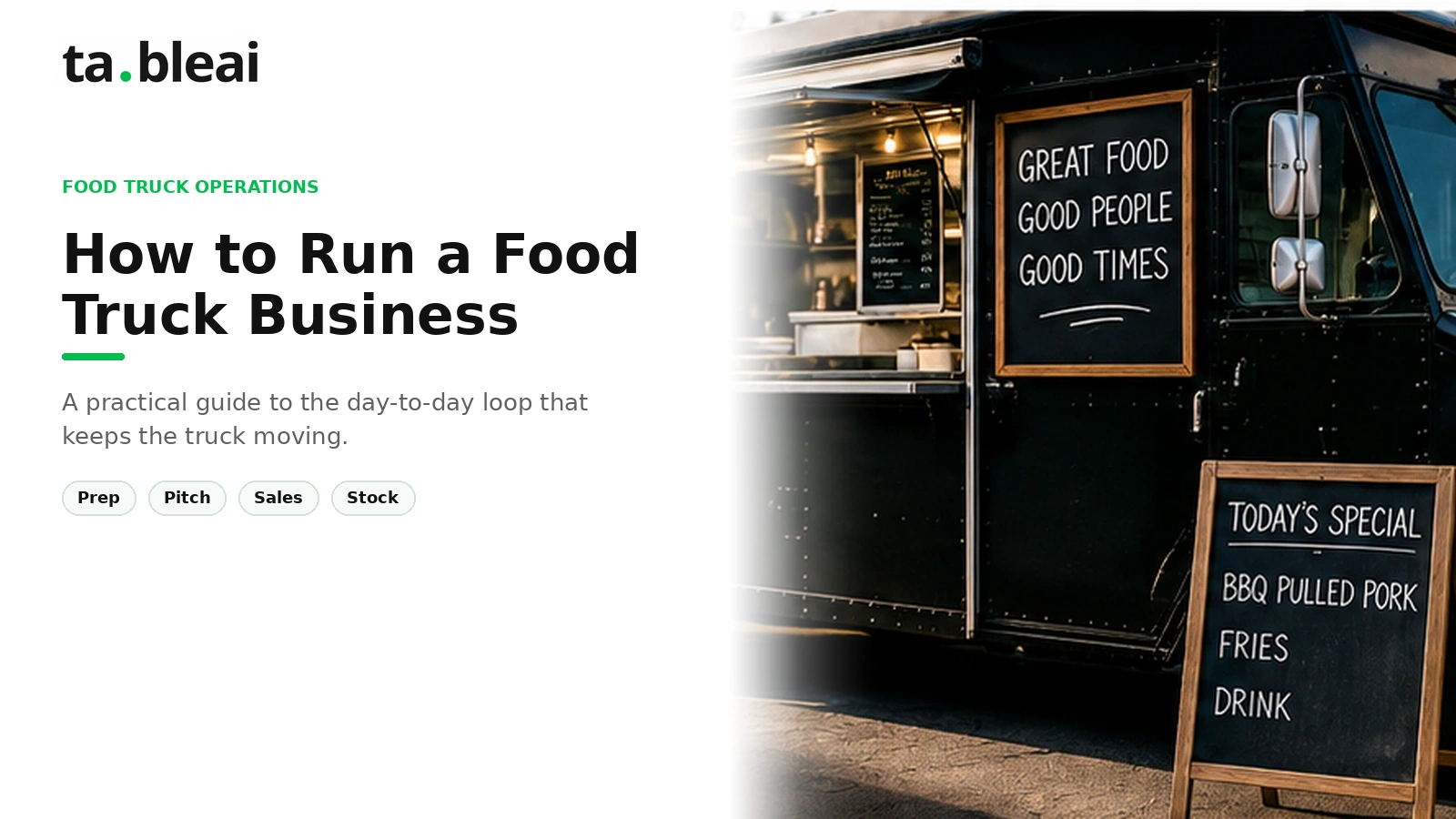
Most guides on running a food truck are really guides on starting one — permits, buying the truck, choosing a concept. Useful once. But once the truck is on the road, the job changes completely. Running a food truck day to day is a tight loop of prep, driving, a short serving window, breakdown, and knowing your numbers well enough to pick a better pitch next week.
To run a food truck day to day: prep each item to a par level set from that pitch's sales history, park where your customers actually are at your service time, run a fast two-to-four-hour window, log the day's total sales with cash and card split out, watch low stock on a kitchen you can't restock mid-service, keep a cross-trained crew of two to three, and review profit by pitch each week. That loop — not the cooking — is what keeps a truck in business.
The rest of this guide walks through each part. It's about running a truck, not opening one and not what it costs to start. If you want the money side, we cover food truck startup and running costs separately.
The short answer: what running a food truck actually involves
Day to day, running a food truck comes down to six moving parts:
- Prep to par. Cook and pack the right amount of food before you roll, based on what that pitch and day usually sells.
- Pick and confirm your pitch. Where you park decides your day. Good spot, good day. Bad spot, wasted prep.
- Run a fast service window. Most trucks serve in a two-to-four-hour burst, so speed at the window is the whole game.
- Track sales and cash daily. Total, cash-vs-card split, logged every single day so you can compare pitches.
- Manage inventory on a moving kitchen. You can't over-hold, you can't restock mid-service, so low-stock awareness matters more than on a fixed kitchen.
- Staff a tiny crew — usually two to three people, all cross-trained, because one no-show can close your window.
The owners who make it aren't the best cooks. They're the ones who know their numbers per pitch and prep to them. Below is how each part works.
Prep and par levels: cook to the day, not to the walk-in
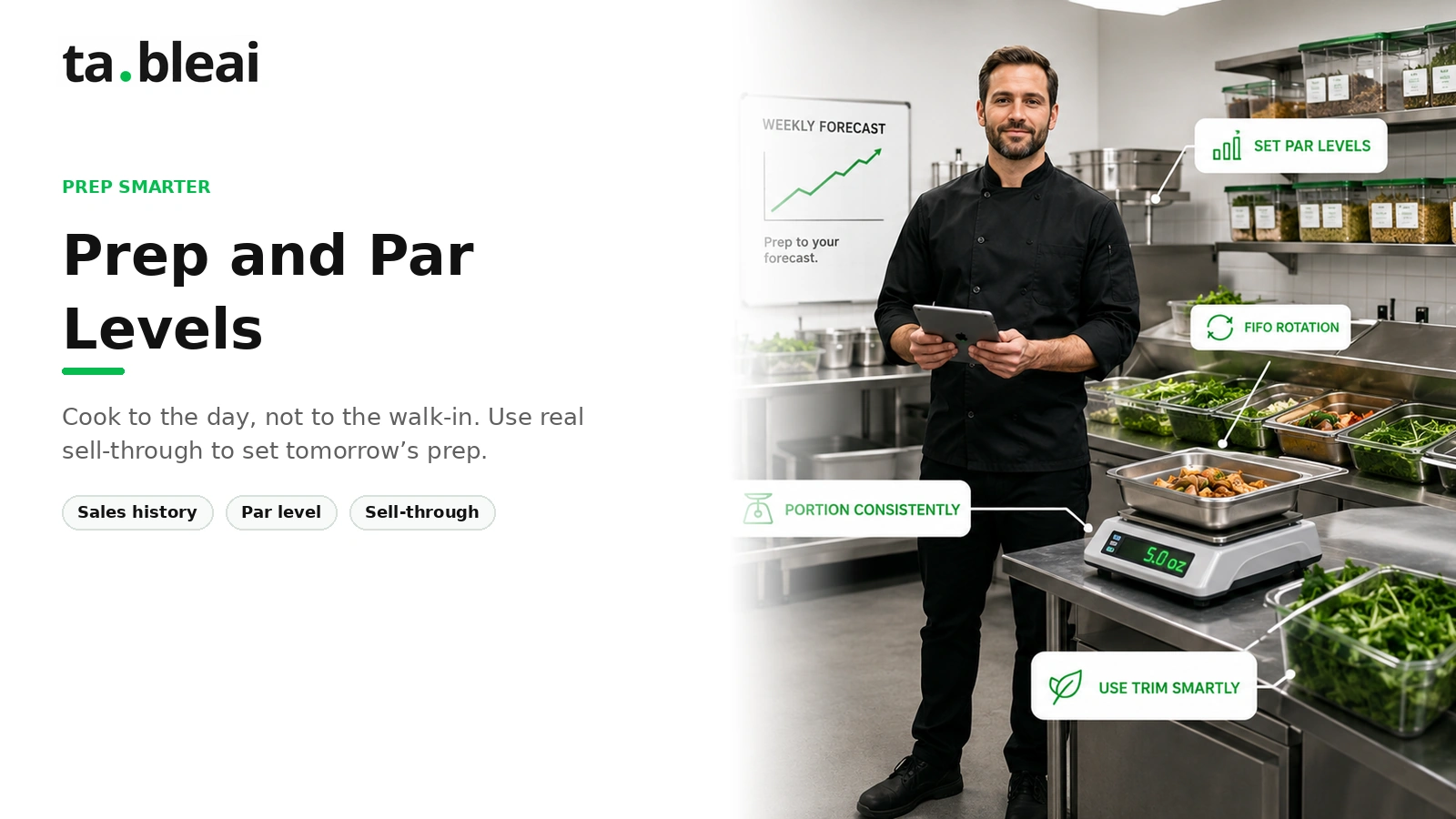
The single most expensive daily mistake on a food truck is prepping the wrong amount. Over-prep and you throw food away or drag it to the next day past its best. Under-prep and you sell out early and turn away the customers who make your best hours profitable.
The fix is par levels — a target quantity of each item you keep ready for a given service. Instead of "make a lot of chicken," you decide "this Friday lunch pitch needs 12 kg of chicken prepped." That number comes from your own sales history for that pitch and that day of the week.
A simple way to set pars:
- Start from your last few services at the same spot. If last three Fridays at the office park sold roughly 90, 85, and 95 portions, those average about 90, so prep around 90 with a little slack for a strong day rather than to the highest day you've ever had.
- Adjust for known events. A festival or a game day nearby means prep up. Rain and a slow week means prep down.
- Track your actual sell-through. If you consistently end the day with food left, your par is too high. If you sell out an hour before close, it's too low.
- Par your packaging and consumables too: cups, containers, napkins, gloves, foil. Running out of clamshells stops service just as hard as running out of food.
Par levels only work if you know what you sold last time at that location. That's why sales tracking (below) is more than paperwork. It's the input to tomorrow's prep. Prep to par, adjust weekly, and your food cost and your waste both come down.
Choosing a pitch: your location is your daily revenue
On a fixed restaurant, location is a one-time decision. On a truck, you choose it again every day, and it's the biggest lever on the day's take. A great spot with mediocre food beats great food in a dead lot.
What makes a pitch worth prepping for:
- Foot traffic at your service time. An office district is gold at lunch and empty at 7pm. A bar strip is the reverse. Match the pitch to when you actually serve.
- Low competition for that exact window. Three trucks on one corner split the crowd. Being the only option near a busy workplace is worth driving further for.
- A clear, legal place to park and set up. Confirm the permit, the pitch fee, and that you're allowed there before you prep, not after you arrive.
- Repeatability. A spot that works one Tuesday and works the next Tuesday lets you build a par level and a regular crowd. One-off events are good money but unpredictable.
Keep a simple record of how each pitch performs. After a few weeks you'll know your Tuesday office-park pitch reliably does more than your Wednesday industrial-estate one, and you can stop guessing. The goal is a rotation of proven spots plus the occasional tested new one — not a fresh gamble every morning.
Tracking daily sales and cash on the road
You cannot manage what you don't measure, and on a food truck the measuring has to happen at close-out, in a hurry, often standing in a parking lot. So it has to be fast, or it won't happen.
At minimum, capture three numbers every service:
- Total sales for the day.
- The cash portion, because cash is easy to lose track of and important for reconciliation.
- The card portion, from whatever reader or app you use to take cards.
Sales tracking is the record. Cash control is what keeps that record honest and your money accounted for. A few habits handle it:
- Start with a counted opening float. Set the cash box with a known amount at the start of service and write it down, so you always know what you began with.
- Count and reconcile at close. Count the drawer, subtract the float, and check it against your cash sales for the day. The gap is your over/short, and a repeating short is a sign to look closer.
- Do interim cash drops on busy days. During a festival or a lunch rush, pull big bills out of the box periodically and move them to a safe spot in the truck, so a full drawer never sits at the window.
- Bank on a routine. Deposit takings on a set schedule instead of letting cash pile up, and your books stay current and your risk stays low.
Log the day's numbers against the pitch and the date, the same way every day, so they are comparable across days and locations. That's the whole point: comparability. "Sold $1,900 today" means nothing on its own. "Sold $1,900 at the office-park Friday pitch, vs $1,600 the last two Fridays" tells you the pitch is trending up and worth defending.
You don't need a full POS to do this. Plenty of trucks run on a card reader plus a cash box and record the day total by hand or by phone. If you'd rather not keep a spreadsheet, we walk through simple options in how to track restaurant sales without a POS. The method matters far less than the discipline of logging it every single day. Skip a few days and the whole history stops being useful. You can no longer trust the comparison, so you stop looking, and you're back to guessing prep from memory.
Inventory on a moving kitchen
Inventory on a truck is a different problem than inventory in a restaurant. You have almost no storage, no room to over-hold cold items safely, and, most critically, no way to restock in the middle of service. Once the window opens, what's on the truck is all you have.
That changes the priorities:
- Load to par, verified. Don't assume the truck is stocked. Check consumables and key ingredients against your par list during load-out, before you drive off.
- Know your low items before you leave the commissary. The cheapest time to discover you're short on chicken is at 6am at your prep kitchen, not at noon at the window. Note that a commissary or commercial prep kitchen is usually a legal requirement for your permit in most areas, not just a convenience, so this stop is part of operating legally.
- Rotate stock (FIFO) and respect holding temps. A moving kitchen bounces and heats up; first-in-first-out and correct fridge and hot-hold temperatures keep you safe and legal.
- Track what's running low across days, not just today. If you're constantly short on one item, that's a signal to raise its par or your standing supplier order, not to keep firefighting it every morning.
The practical move is a running low-stock list you actually check. Some owners keep it on paper by the prep station; others text it to a tracker so the reminder surfaces the next morning. However you do it, the aim is to never learn you're out of something during service.
Keep your supplier contacts one tap away
When you do run short, you need to reorder fast — usually from your phone, often between services. Keep your suppliers' numbers stored and current so a restock is one message, not a scramble through old texts. A shortcut a lot of truck owners use: store supplier contacts and low-stock notes in the same place, so "we're low on buns" and "here's the bun supplier's number" live together.
Staffing a tiny crew
Most food trucks run service with two to three people, and every one of them matters because there's no bench:
- The line: one person cooking and assembling.
- The window: one person taking orders, handling payment, and handing out food.
- A third, during rushes: prep, expediting, or a second pair of hands on the window when the line gets long.
Two rules keep a small crew from breaking:
Cross-train everyone. On a three-person truck, one no-show is 33% of your labor gone. If your window person can't step onto the line, a single sick call can close you for the day. Everyone should be able to cover the next station over.
Track attendance simply. You don't need shift-management software for a two-person crew, but you do need to know who showed, who was late, and who's on for the next pitch, especially when you're running multiple trucks or trading shifts. A quick log ("Sam in, Alex late 20 min") is enough, and it's the kind of note you can fire off from your phone during setup.
Because the crew is small, the owner is usually in service, not watching it. That's exactly why the tracking has to be low-effort — you're doing it between orders, not from a back office.
Knowing your numbers: the difference between busy and profitable

Plenty of food trucks are busy and still lose money. The ones that last know, per pitch, whether they're actually making anything after food, labor, fuel, and fees.
You don't need accounting software to get this directionally right. For each pitch, roughly:
- Sales for the day (you're already logging this).
- Food cost: what the day's ingredients cost, or a reliable food-cost percentage of sales.
- Labor: hours times pay for the crew that day.
- Fuel and the pitch/event fee: the fixed cost of showing up there.
If sales reliably clear all of that with margin left, the pitch works — defend it and build regulars. If a pitch barely breaks even week after week, drop it, however fun the crowd is. This is the review that separates a hobby from a business — and you can only do it if the daily numbers exist. Guessing from memory always flatters you, because you remember the good Fridays and forget the dead Wednesdays.
Set aside 15 minutes once a week to look at the numbers by pitch. That weekly habit — not any single tool — is what turns a food truck from a grind into something you can steer.
How TableAI fits into running a food truck
Everything above needs one thing: your daily numbers, captured without slowing you down. That's the specific gap TableAI for food trucks fills.
TableAI is a WhatsApp-based tracking tool, not a POS. It doesn't process cards or print receipts — you keep whatever card reader and cash box you already use. Instead, you text it what happened: "sold $1,900 today" logs the sale, "got 20kg chicken" logs the stock, "Sam in, Alex late" logs attendance. Every morning at 7am it sends a briefing (yesterday's numbers, what's running low, what to expect today) so you prep to par instead of from memory. It also stores your supplier phone numbers so a restock is one tap.
Where it's not the fit: if you need a full point-of-sale to take orders at a high-volume window, split checks, or push sales straight into accounting, you want a real POS, not a texting tool. TableAI sits alongside your existing setup for the tracking layer, not in place of a POS.
Pricing is a flat rate in the ~$29-49/month range, free during early access, with direct founder-run support over WhatsApp. See pricing for details.
Frequently asked questions
What does a normal day running a food truck look like?
A typical day is prep and load-out in the morning, drive to your pitch and set up, a lunch or dinner service window of two to four hours, then break down, restock, clean, and close out the cash and sales for the day. Most owners spend more hours on prep, driving, and cleanup than on actual serving.
How do you track sales on a food truck without a POS?
Log your daily total at close-out with cash and card split out, ideally the same way every day so the numbers are comparable. Many owners jot it on a sheet or send it to a phone-based tracker like TableAI by texting the day total. The key is capturing it every single day, not the tool you use.
How much food should a food truck prep each day?
Prep to a par level, which is the amount you need on hand to get through a normal service for that day and location. Set pars per item based on your sales history for that pitch and day of week, then adjust up for events and down for slow days. Prep to par, not to a full walk-in.
How many staff does a food truck need?
Most trucks run with two to three people during service: one on the line cooking, one on the window taking orders and payment, and sometimes a third for prep or expediting during rushes. Cross-train everyone so a no-show does not close your window.
How do you know if a food truck is actually profitable?
Track daily sales against your food cost and labor for each pitch, and compare pitches over a few weeks. A location is working if sales reliably cover food, labor, fuel, and your pitch or event fee with margin left. Guessing from memory hides your worst days, so record the numbers.
The bottom line
Running a food truck day to day comes down to a loop, not a secret recipe: prep to par, pick a proven pitch, run a fast window, log the sales, watch your low stock, keep a tiny crew covered, and review the numbers by pitch each week. Get that loop tight and the truck runs like a business instead of a scramble.
The only tool that loop truly requires is a way to capture your daily numbers without slowing down at close-out. Do that consistently and everything else follows from it: better prep, better pitches, better margins.