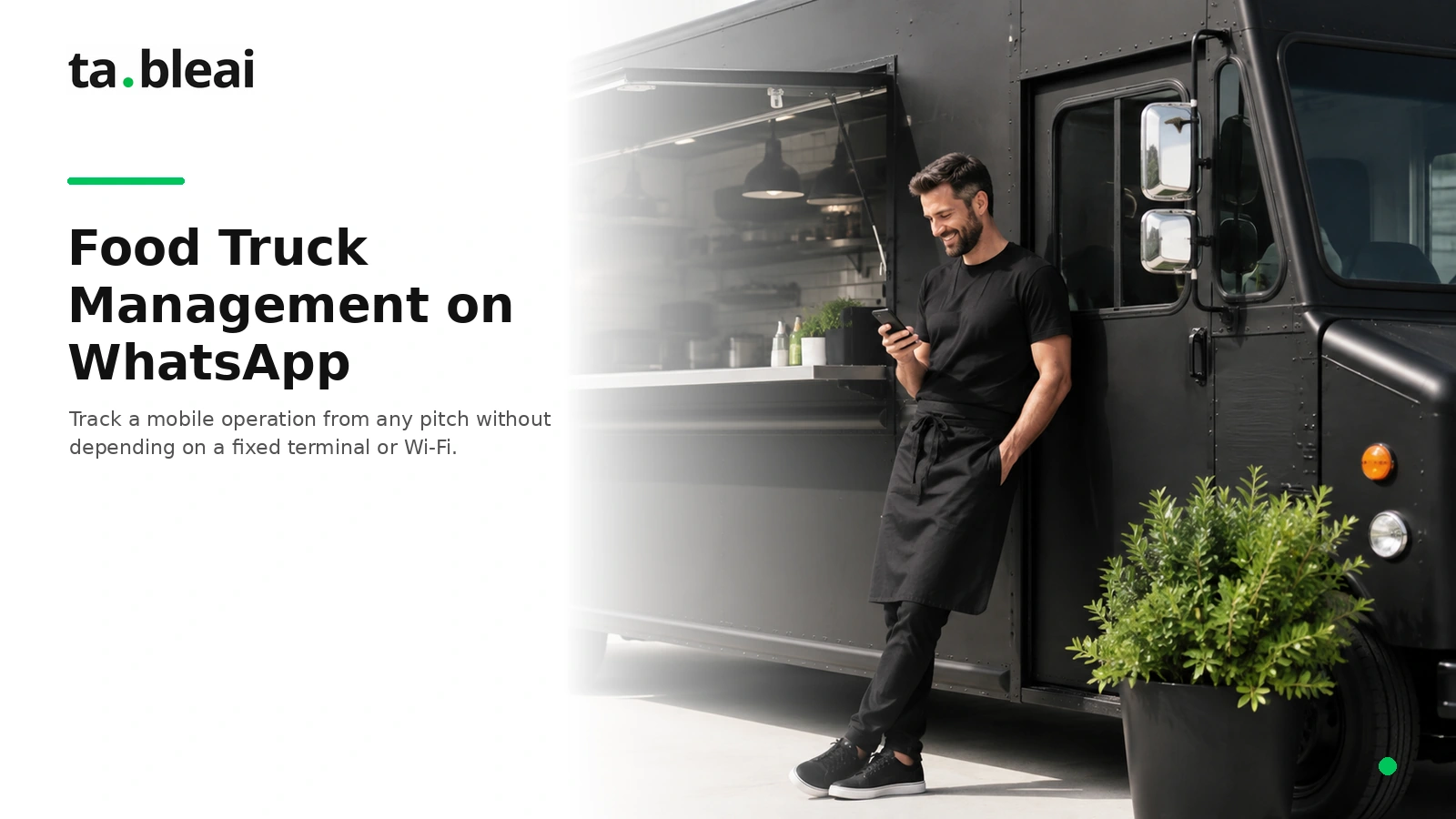
For food trucks
Your truck moves. Your POS doesn't.
TableAI works anywhere your phone works. No fixed terminal, no wifi dependency, no counter to hide it behind.
The problem
Three things that quietly kill food truck operations
A food truck's whole business moves, but the numbers usually stay in your head. Which spot actually paid, what you sold before the lunch line broke, how much prep walked home uneaten. On a good day you're too busy to write it down. On a slow day you can't remember. It's a big part of running a food truck that rarely makes the setup lists.
The commissary run
You loaded 40 lbs of chicken at 6am. By service you can't remember if it was 30 or 40 or 50.
TableAI logs it when you text "loaded 40 lb chicken." Real inventory, no clipboard.
Which lot actually made money
Downtown Friday felt busy. Was it more than Wednesday's park? You'd have to add up receipts.
TableAI tags sales by location. See which spots pay off, drop the ones that don't.
Where's the truck
Your line cook texts asking. Your partner asks. You send the same pin 4 times a day.
TableAI keeps your current location. Anyone with access asks the bot instead of you.
How it works
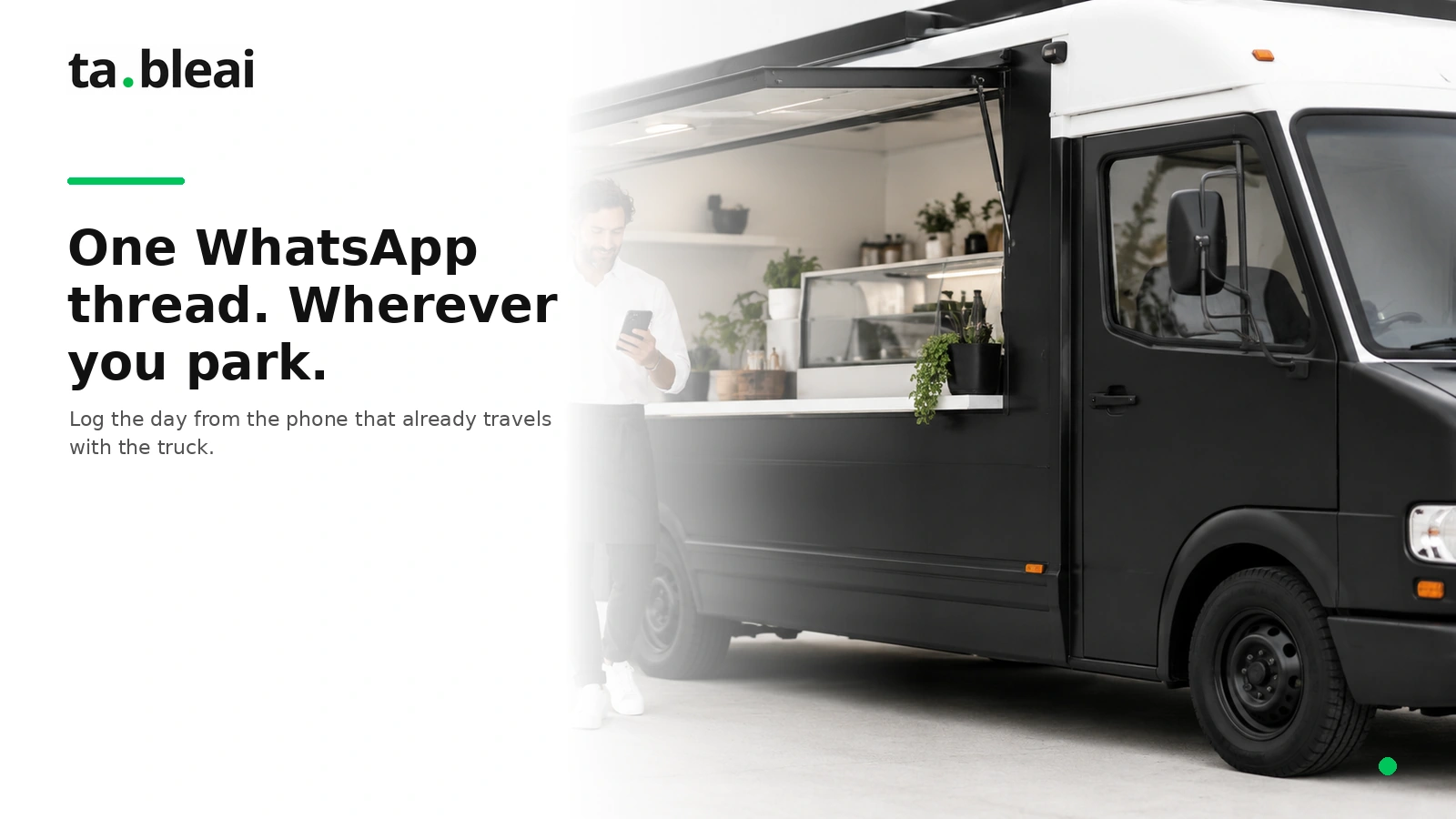
One WhatsApp thread. Wherever you park.
No terminal bolted to the counter and no dashboard to open between orders. It works over WhatsApp on whatever signal you've got.
Text it from the window
"Sold 120 at the park, buns low, ran out of slaw." A quick line while the grill cools down.
It logs the day
Sales by spot, stock, prep, and staff, kept in order without balancing a laptop in a cramped truck.
Plan tomorrow from real data
A morning briefing shows which locations pay, what's low, and how much to prep before you roll out.
A day on the road
From load-in to last order
You load in and read the briefing. The park beat the office lot last week, buns are low, one is on with you today.
Lunch line is out the door. You text "out of slaw" so tomorrow's prep isn't short again.
Between spots you log "sold 120, moving to the brewery." Each location's take is tracked on its own.
Park up and close with "brewery did $600, buns and patties low." Reorders are set before the morning.
Being honest
TableAI isn't for stationary operations.
- If you're a fixed restaurant with a card reader glued to the counter, use Toast — it's designed for that
- If you need advanced kitchen display screens or route optimization, TableAI won't do those
- If you're processing 500+ orders/day, you probably need a real POS with printer integration
- It doesn't help you find parking permits or negotiate with lot owners
It does one thing: keep track of what happened at every stop, so you can look back at the week and know which lots to work again.
Why this matters
The math behind mobile food
$346K
Average annual revenue for a U.S. food truck (2024)
6.2%
Food truck profit margin — vs 1-3% for traditional restaurants
91%
Share of U.S. food trucks that are independently owned
Sources: IBISWorld · IBISWorld 2024 · B2BReviews industry data
On the road
What food truck owners check first
Does TableAI need internet at the truck?
It runs on WhatsApp, so it works on whatever mobile signal you have, without a fixed terminal or a reliable counter connection.
Can it track sales by location?
Yes. You note where you parked along with the day's numbers, and the briefing shows which spots actually pay so you can plan your route.
Do I need a POS or card reader?
No. TableAI does not process payments. Keep your reader or cash and use TableAI to track sales, stock, and prep.
Is it worth it for a one-person truck?
That is exactly who it is built for. It replaces the notebook and the memory, not a back-office team, and it takes a sentence a day.
What does TableAI cost?
Flat pricing of roughly $29 to $49 a month, and it is free during early access, with nothing to install.
Doing the road math? See our flat pricing, or break down what a food truck really costs.
Keep learning
Guides for running a food truck
Ready to track your truck from wherever it's parked?
Free during early access · No card required · Nothing to install