Ask any owner of a well-run restaurant when they know what happened yesterday. Some can answer before 7am. Most can't answer until they're in the office at 10 or 11 — sometimes not until closing that night. The gap between those two owners is a morning briefing. This post is about why that matters and how to build one, whether you're a solo operator with an iPhone or a team with a general manager.
For written context between shifts, use the free manager logbook template. It records unresolved issues, action owners and deadlines before the next manager takes over.
The short version
If you don't want to read the whole thing:
- A morning briefing is a 5-minute summary of yesterday's sales, today's staffing, and anything urgent. It arrives before you start your day.
- The best-run restaurants have one. Most independents don't. Not because it's hard — because no one built the habit.
- Solo operators can do it themselves with a spreadsheet, a template, or a chat-based tool.
- Teams should have their manager send it every morning at a set time (7am is standard) via text, email, or Slack.
- The point is not the numbers — it's ending decision paralysis. You know what happened. You know what's on today. You act.
What is a "morning briefing" for a restaurant
Big restaurant groups have had morning briefings for decades. General managers get a report at 7am summarizing yesterday's sales, top items sold, labor cost percentage, and any operational issues. They read it while their coffee brews. By the time they arrive at the restaurant, they already know whether they're having a good week, whether there's a supplier problem, whether they need to make schedule adjustments.
Independent restaurants almost never have this. Instead, the owner walks in mid-morning, looks at the POS, gets a rough sense of yesterday, and reacts to whatever's on fire. The difference is small each day and compounding over a year.
A morning briefing is the daily practice of ending yesterday cleanly and starting today with information.
What it should contain
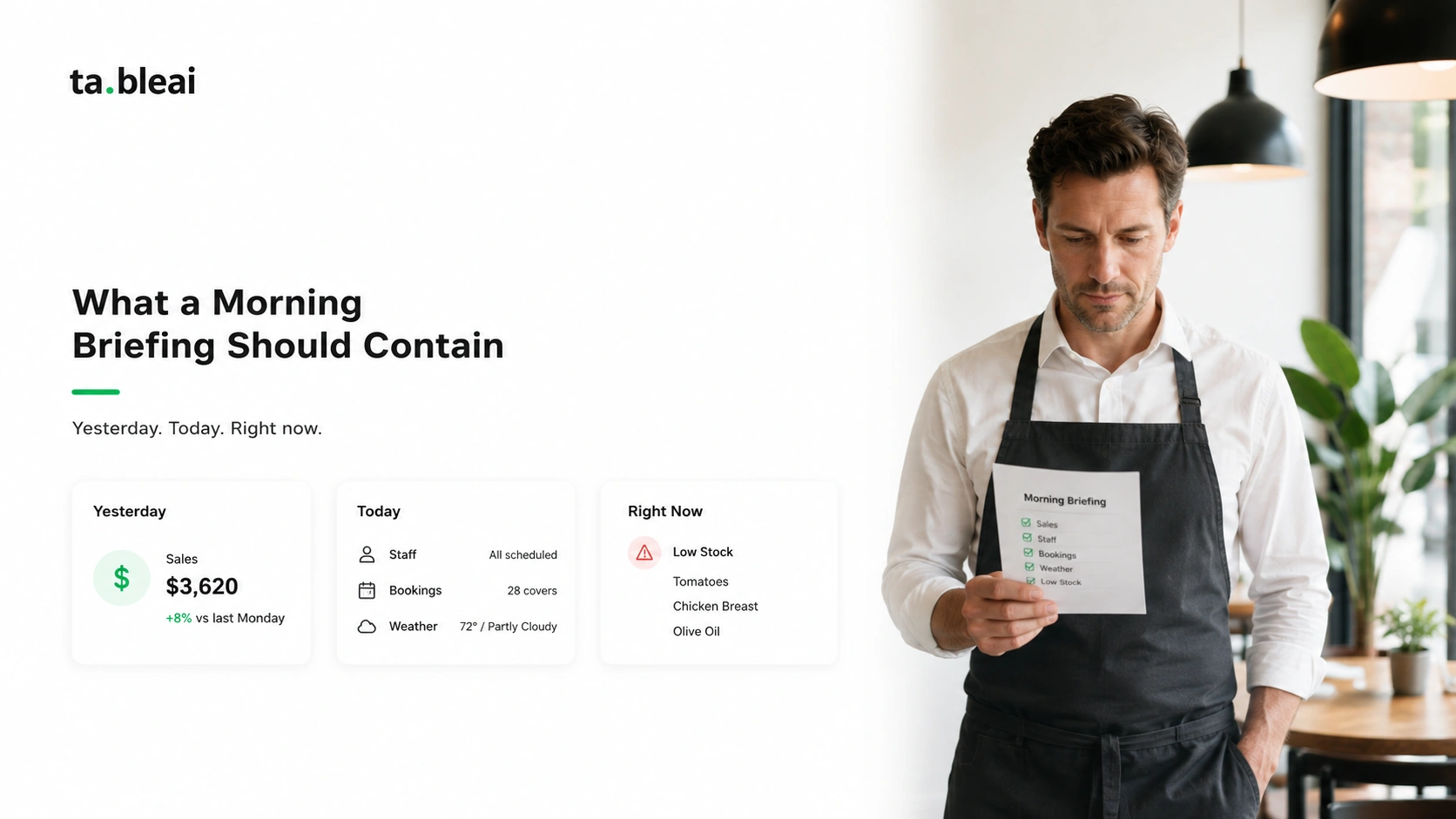
A useful morning briefing is short. If it's more than one screen on a phone, no one reads it. Here's the minimum viable version:
Yesterday
- Total sales
- Comparison to same day last week (percent up or down)
- Top-selling item or category (optional but useful)
- Anything notable that happened (big party, walkout, equipment failure)
Today
- Weather forecast (affects walk-in traffic)
- Staff scheduled (who's on, any call-outs already)
- Any known bookings or events
- Any deliveries expected
Right now
- Anything running low that needs ordering
- Anything broken that needs fixing
- Anything that affects opening (staff shortage, supply shortage, weather)
That's it. Ten data points, five minutes of reading, before your first customer walks in.
Some restaurants add more — labor cost percentage, food cost trend, week-over-week revenue — but these are secondary. The core briefing is: what happened yesterday, what's happening today, what needs attention right now.
Why most restaurants don't have one
It's not that owners don't want to know this information. It's that gathering it every morning is friction, and friction kills habits.
To assemble a real morning briefing manually, you'd need to:
- Pull yesterday's sales report from your POS
- Compare it to same day last week (manual calculation)
- Check who's scheduled today (another system or paper)
- Check the weather
- Remember what deliveries are coming
- Compile all of it into something readable
- Do all of the above before 7am
That's 15-30 minutes of morning work every day. Nobody sustains that. So the briefing doesn't happen, and the owner walks in mid-morning without context.
This is why chat-based tools have started to win in restaurant operations. If you're texting your daily sales into a system anyway, it can send you the briefing automatically. No compilation work. Just: information appears at 7am, you read it, day starts.
The 4 ways to actually build a morning briefing
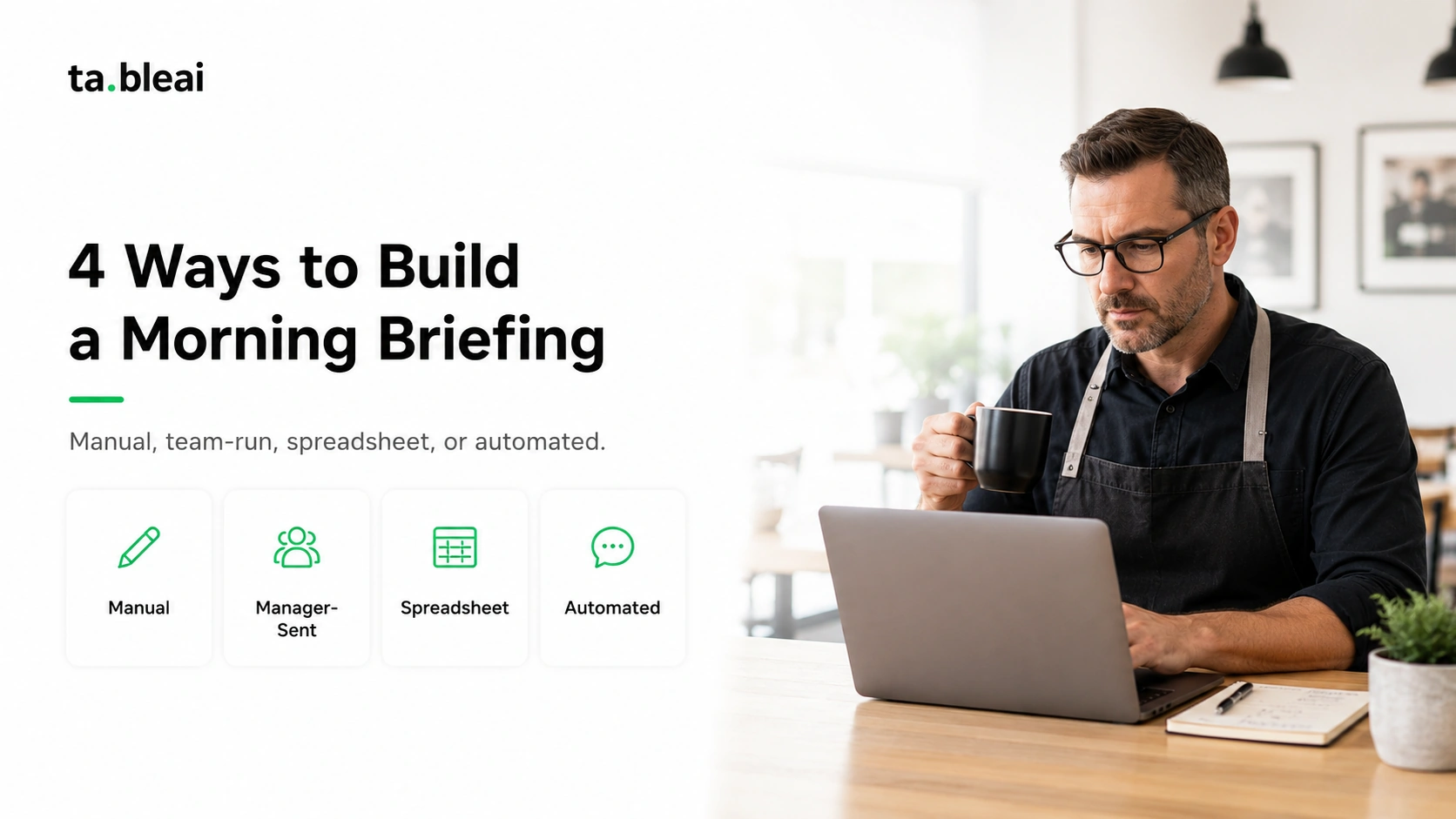
Option 1: Solo owner, manual
How it works: Every night at close, you write the next morning's briefing in a notes app. Include yesterday's numbers, today's plans, and anything urgent. Read it at 7am with coffee.
Cost: Free.
Best for: Owners who close their own restaurant most nights.
Honest tradeoffs: Requires nightly discipline. Falls apart when you don't close (someone else is on the shift). But it's a legitimate start.
Template:
Wed, Aug 27 — closing brief

Yesterday (Tue): $2,840
Last Tue: $2,650 (+7%)
Notable: 15-top at 7pm; kitchen ran out of salmon

Today (Wed):
- Weather: 72°F, sunny
- Staff: Ana, Mike, Lisa. Ana late 30 min (dentist)
- Bookings: 22 covers on the books
- Delivery: produce, 11am

Now:
- Order salmon before 10am (out)
- Espresso machine needs descale
- Water bill due Friday
Written the night before. Read the morning after. Five minutes to write, one minute to read.
Option 2: Team-run, manager sends daily
How it works: Your general manager assembles the brief every morning and sends via text/email/Slack to you (and anyone else who needs it). Same template as Option 1, but a team member owns the daily discipline.
Cost: Free (uses tools you already have).
Best for: Restaurants with a manager who's on-site early or who closes and can pre-write it.
Honest tradeoffs: Depends entirely on the manager's discipline. If they miss a day, you have no briefing. If they're inconsistent about what they include, the value degrades.
Setup: Write the template. Give it to the manager. Set the expectation: "I want this by 7am every day, no exceptions. If you're not going to be around, someone else does it or you send it the night before."
Option 3: Spreadsheet with daily formula
How it works: Google Sheet with columns for daily sales, weather, staff, notes. Formulas auto-calculate week-over-week comparisons. You fill in "yesterday" section end-of-day. In the morning, you review + add "today" notes.
Cost: Free.
Best for: Owners already using spreadsheets for sales tracking. Adding briefing on top is minimal extra effort.
Honest tradeoffs: You still have to write and read it manually. But the historical comparisons happen automatically, which is where most manual briefings break down (nobody wants to do math at 6:30am).
Bonus: Six months of daily briefings in a spreadsheet becomes a genuinely useful searchable log. "When did the espresso machine break last time?" — Ctrl-F, done.
Option 4: Automated chat-based briefing (TableAI, similar)
How it works: You text your sales, staff notes, and inventory alerts to a WhatsApp number throughout the day/night. The system compiles everything into a morning briefing and sends it to you at 7am the next day.
Cost: TableAI is free during early access; planned pricing $29-49/month.
Best for: Owners who don't want to manually compile briefings but want them to arrive automatically. Especially good for solo operators who don't have a manager to delegate to.
Honest tradeoffs: You still have to text in the raw data (sales totals, notable events). The system's job is compilation and delivery — you're outsourcing the manual work of writing the brief, not the data entry.
Category note: This is a very new category. The morning-briefing-as-a-service model didn't exist before 2024 because WhatsApp Business API access was too expensive for small operators. Now that access has opened up, expect more tools in this space.
What NOT to put in your morning briefing
Restaurants that try to build the "perfect" briefing usually kill it with too much. Here's what to leave out:
Anything that isn't actionable today. Monthly food cost trends belong in a monthly review, not a daily brief. Yearly comparisons are quarterly conversations.
Marketing metrics. Instagram engagement, email open rates, review scores — these are weekly-review topics. They don't help you make today's decisions.
Anything requiring interpretation. "Sales were $2,840 yesterday" is actionable. "Sales were down 3% but revenue-per-cover was up 2% while table turnover slowed 5%" is a report, not a briefing. Save analysis for the weekly review.
Everyone's shift feedback. Some restaurants try to add "how did Ana's shift go" — this is management theater. Only include staff notes if there's an actionable item (late, no-show, needs coaching).
Long comparisons. Yesterday vs same-day-last-week is the maximum comparison useful daily. Yesterday vs last 12 weeks average is nice-to-have. Yesterday vs 3-year moving average is too much.
Keep the brief under one phone screen. Always. If it doesn't fit, cut something.
The daily rhythm that actually works
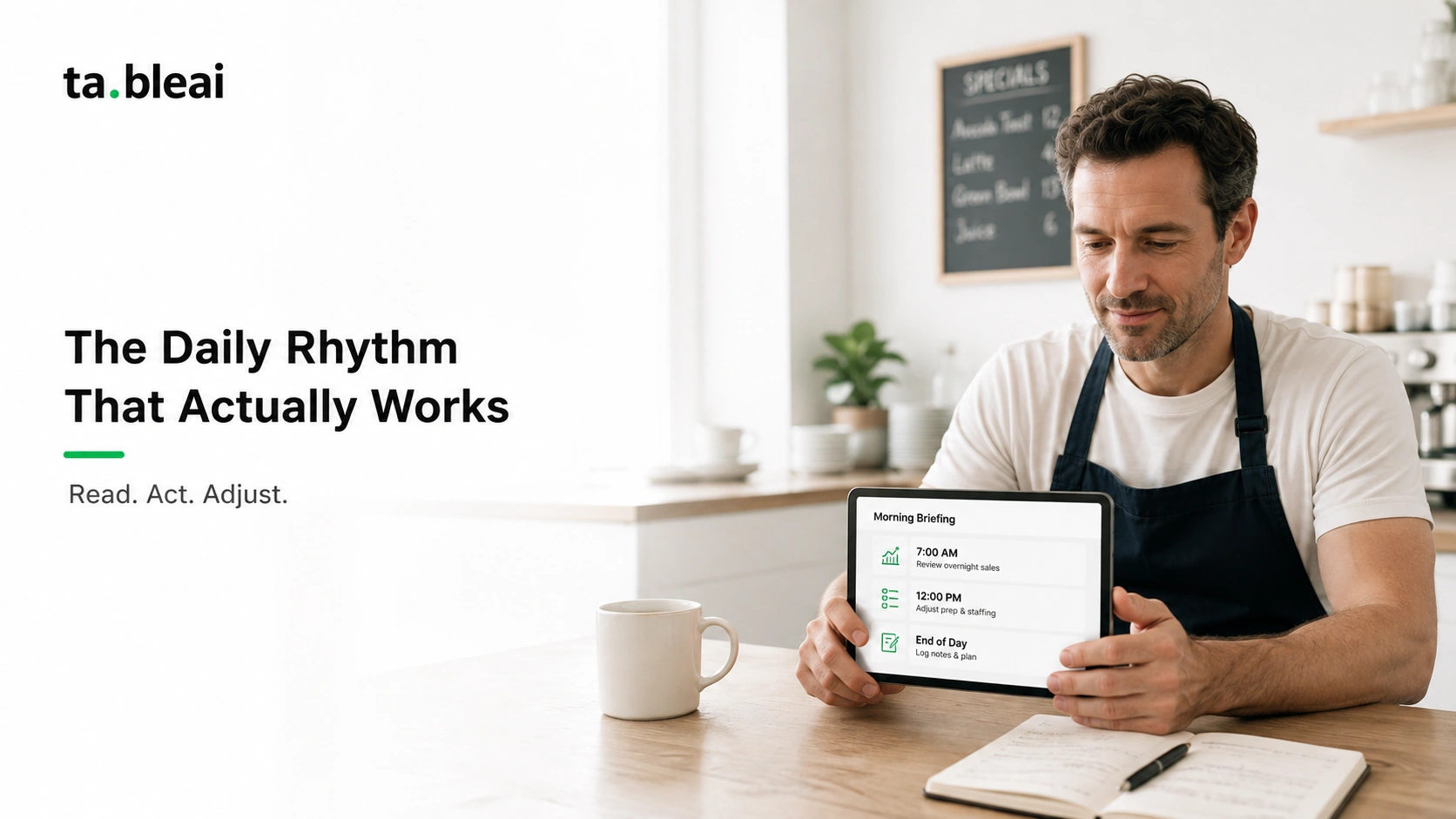
Night before (5 min): Write or generate tomorrow's briefing draft. Include yesterday's numbers, any operational issues, and reminders for tomorrow.
Morning (2 min at 7am): Read the briefing with your first coffee. Note anything requiring action.
Mid-morning (varies): Take the actions the briefing flagged. Order the salmon. Text the electrician. Confirm the booking.
Rest of day: You know what's happening. You have the context. You can respond to the unexpected without also being caught off-guard by the expected.
End of night: Close, capture today's data (sales, notable events), assemble tomorrow's briefing. Repeat.
The whole thing takes 10-15 minutes per day distributed across morning and night. Payoff: you know your business.
What changes when you actually do this
Owners who've built a real morning briefing habit describe the same three shifts:
1. Less anxiety. Instead of walking in and wondering how yesterday went, you know. Instead of guessing what today looks like, you know. Anxiety about the unknown drops. You still have problems, but they're specific problems, not general worry.
2. Faster decisions. You already have the data you'd otherwise have to look up. When your manager asks "should we run the sunset promo tonight?", you already know that Thursday sales are down 12% this month and yes, run it.
3. You catch problems earlier. A 15% drop in Tuesday sales for two consecutive weeks used to take a month to notice (or never). Daily briefing catches it in week two, giving you three weeks of the month to figure out what's happening.
None of these require expensive software. They require the habit.
Common questions
What if I close every night — I already know yesterday's numbers, right?
Sort of. You know today's numbers when you close. But by tomorrow morning, you've slept, and the number is fuzzy. Also, you don't naturally do the comparison ("how does today compare to same day last week"). A briefing formalizes both the memory and the comparison.
Do I really need a briefing if I'm always at the restaurant?
Yes — for a different reason. Being at the restaurant doesn't mean you know what's happening. You know what's in front of you. The briefing forces the wider view: yesterday, today, this week, patterns.
How is this different from a "pre-shift meeting"?
Pre-shift meetings are for the whole team, before service, focused on specials and today's operations. A morning briefing is for the owner/manager, before anything else, focused on the business as a whole. Different purposes. Some restaurants do both.
Can I skip weekends?
If you skip Saturday and Sunday briefings, you don't know how your two busiest days went until Monday morning. Which is often too late to make schedule adjustments. Weekend briefings matter more than weekday briefings.
What if my staff pushes back on the data collection?
They shouldn't be doing the data collection — you or your manager should. Line staff don't need to know about food cost percentages or week-over-week trends. Their pre-shift meeting is separate and focused on today's service.
How long before this habit sticks?
Two to three weeks of consistent daily practice is when it becomes automatic. If you make it to day 21, you'll keep doing it. If you skip during week two, you'll probably quit.
Bottom line
A morning briefing is the single highest-leverage habit for restaurant operators. It's not new — big chains have done this forever. What's new is that independents can now build one without an operations team.
If you're a solo owner, use a notes app or a spreadsheet. If you have a manager, have them own the daily brief. If you don't want to compile it manually, use a chat-based tool that assembles it for you.
The tool matters less than the discipline. Owners who build this habit run tighter operations, make faster decisions, and sleep better at night.
TableAI is free during early access — you text sales, inventory, and staff notes to a WhatsApp number, and it sends you a briefing at 7am every morning. If you'd rather build it yourself, the template earlier in this post is a starting point.
Whichever route, start tomorrow. The habit is the whole point.