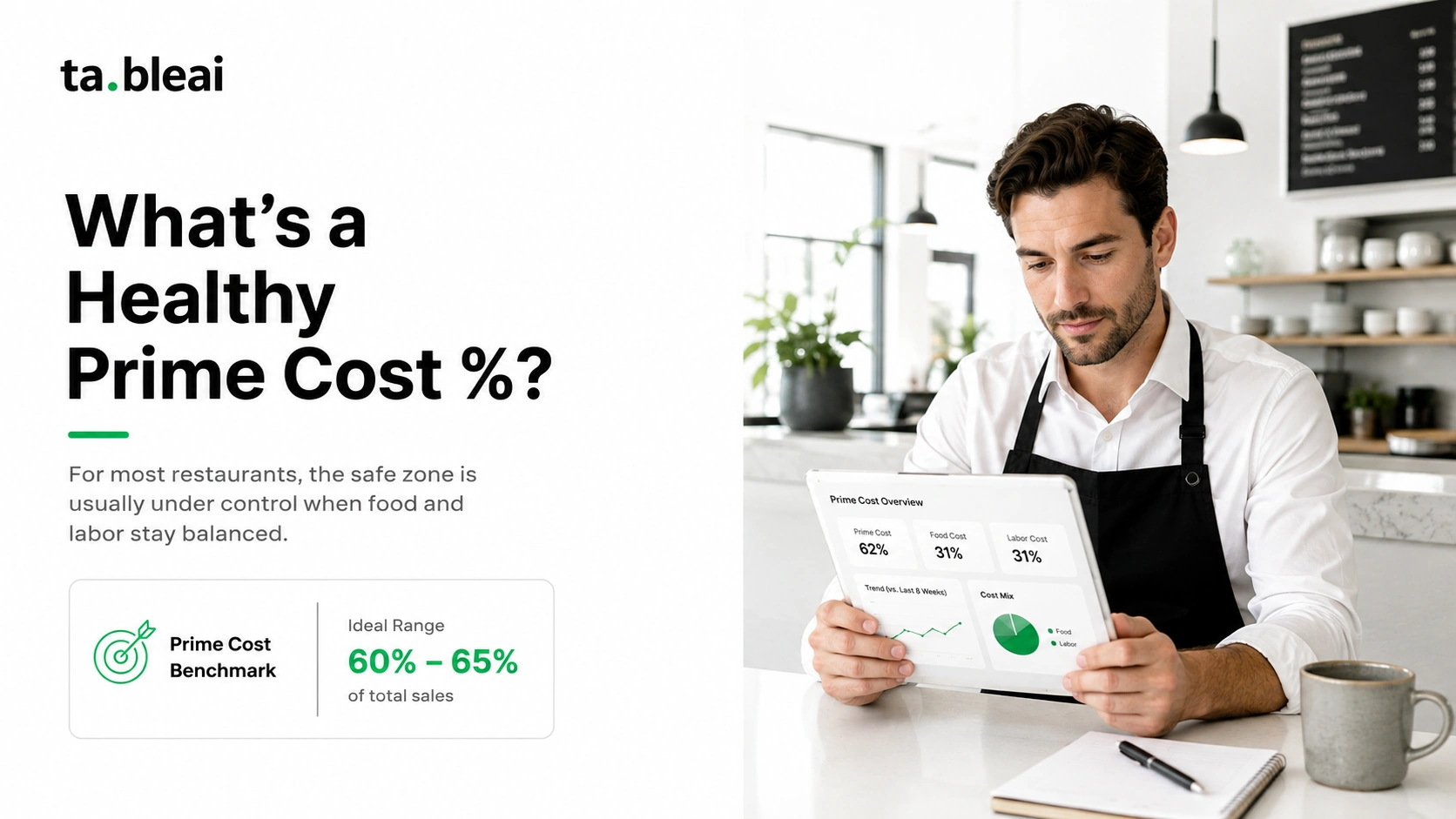
Your restaurant prime cost is the one number that tells you whether the doors stay open, and most owners have never worked it out. They track food cost some months. They complain about the wage bill. But they almost never add the two together, which is exactly where the truth lives. Prime cost is your cost of goods sold plus your total labor, and if it runs too high for too long, nothing else you do matters.
Here is the direct answer up front. Prime cost = COGS (food + beverage) + total labor cost, measured as a percentage of revenue. A healthy independent restaurant commonly targets 55-65% of revenue. Above that range consistently and you are working for your suppliers and your staff, not yourself. Below it and you either have a very tight operation or you are underpaying and about to lose people.
What is prime cost in a restaurant?
Prime cost is the sum of the two costs you can actually control day to day: what you spend on ingredients and drinks, and what you spend on the people who turn those ingredients into sales.
Rent doesn't move. Your insurance premium is what it is. But food cost and labor cost flex every single shift based on decisions you make, and together they typically take 55-65 cents of every dollar that comes in when the operation is healthy — climb much past 70 cents and you're in the danger zone. That is why prime cost is the number operators watch. Everything else on the P&L is either fixed or small by comparison.
The prime cost formula:
Prime Cost = COGS (food + beverage) + Total Labor

Prime Cost % = (Prime Cost ÷ Total Revenue) × 100
Two pieces feed it. COGS is the actual cost of ingredients and drinks consumed, which you get from beginning inventory plus purchases minus ending inventory. Total labor is everything you pay humans: hourly wages, salaried manager pay, your own draw if you take one, plus payroll taxes and any benefits. If you leave out payroll taxes or your own salary, your prime cost looks better than it is and you'll make bad decisions on that fake number.
The prime cost formula with a worked example
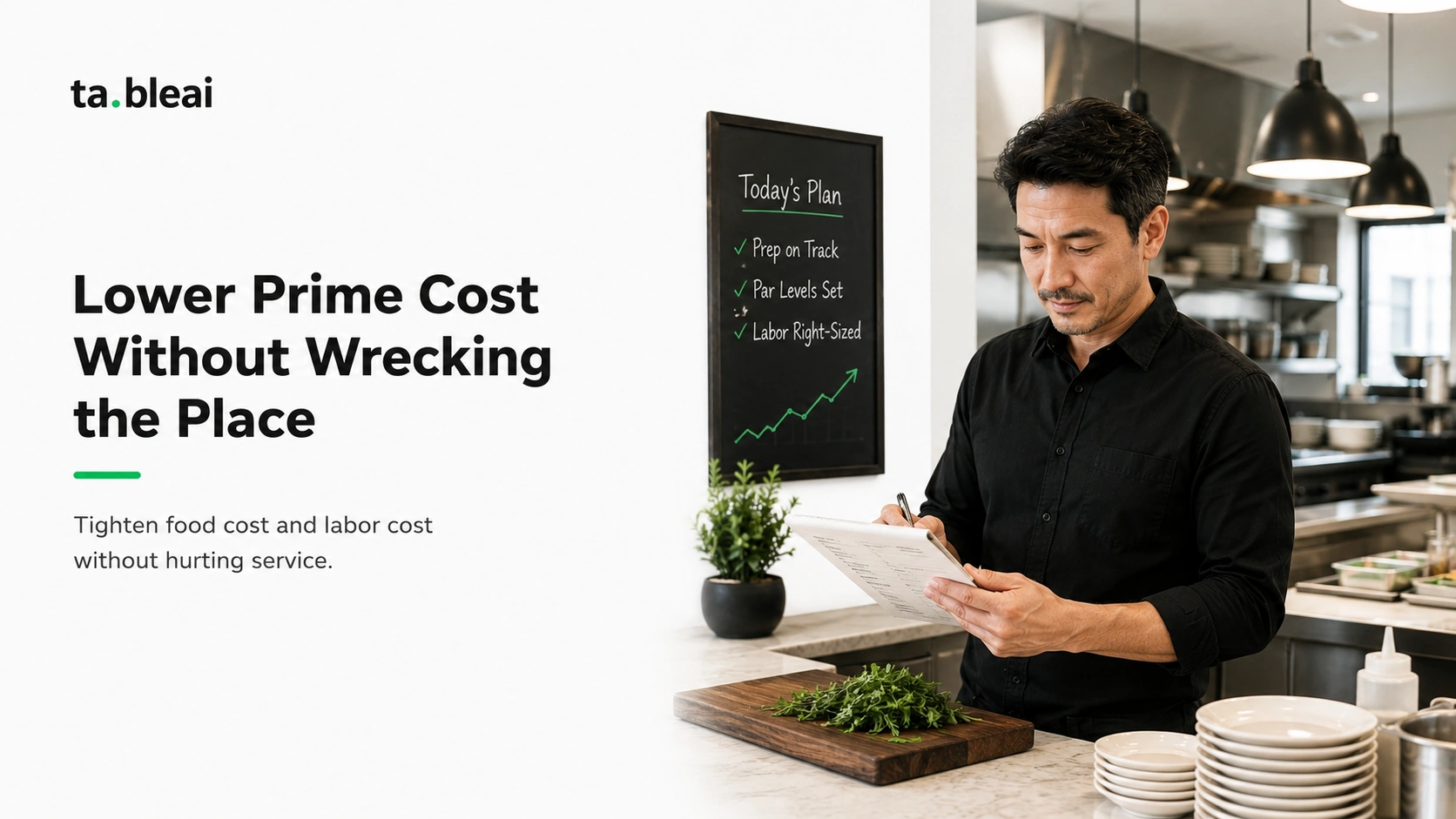
A worked example makes this concrete. Say you run a small full-service spot and you just closed the month.
- Total revenue: $100,000
- Food COGS: $28,000
- Beverage COGS: $4,000
- Hourly wages: $21,000
- Manager salary + your draw: $5,000
- Payroll taxes and benefits: $2,000
Add the ingredient side first:
COGS = 28,000 + 4,000 = $32,000 (32% of revenue)
Then the labor side:
Total Labor = 21,000 + 5,000 + 2,000 = $28,000 (28% of revenue)
Now the number that matters:
Prime Cost = 32,000 + 28,000 = $60,000
Prime Cost % = 60,000 ÷ 100,000 × 100 = 60%
Sixty percent. That sits right in the healthy band. It leaves $40,000 to cover rent, utilities, marketing, repairs, software, and profit. Whether that $40,000 is enough depends on your fixed costs, but at least the controllable half of your business is in order.
Now watch what a small drift does. Suppose portions crept up and food COGS drifted to 35%, and you overstaffed a few slow weeks and labor climbed to 31%. Same $100,000 revenue.
Prime Cost % = 35% + 31% = 66%
That's only six points, and it feels like nothing in the moment. But six points on $100,000 is $6,000 a month, $72,000 a year, gone. That is the difference between a restaurant that pays its owner and one that quietly borrows to stay open.
What is a healthy prime cost percentage?
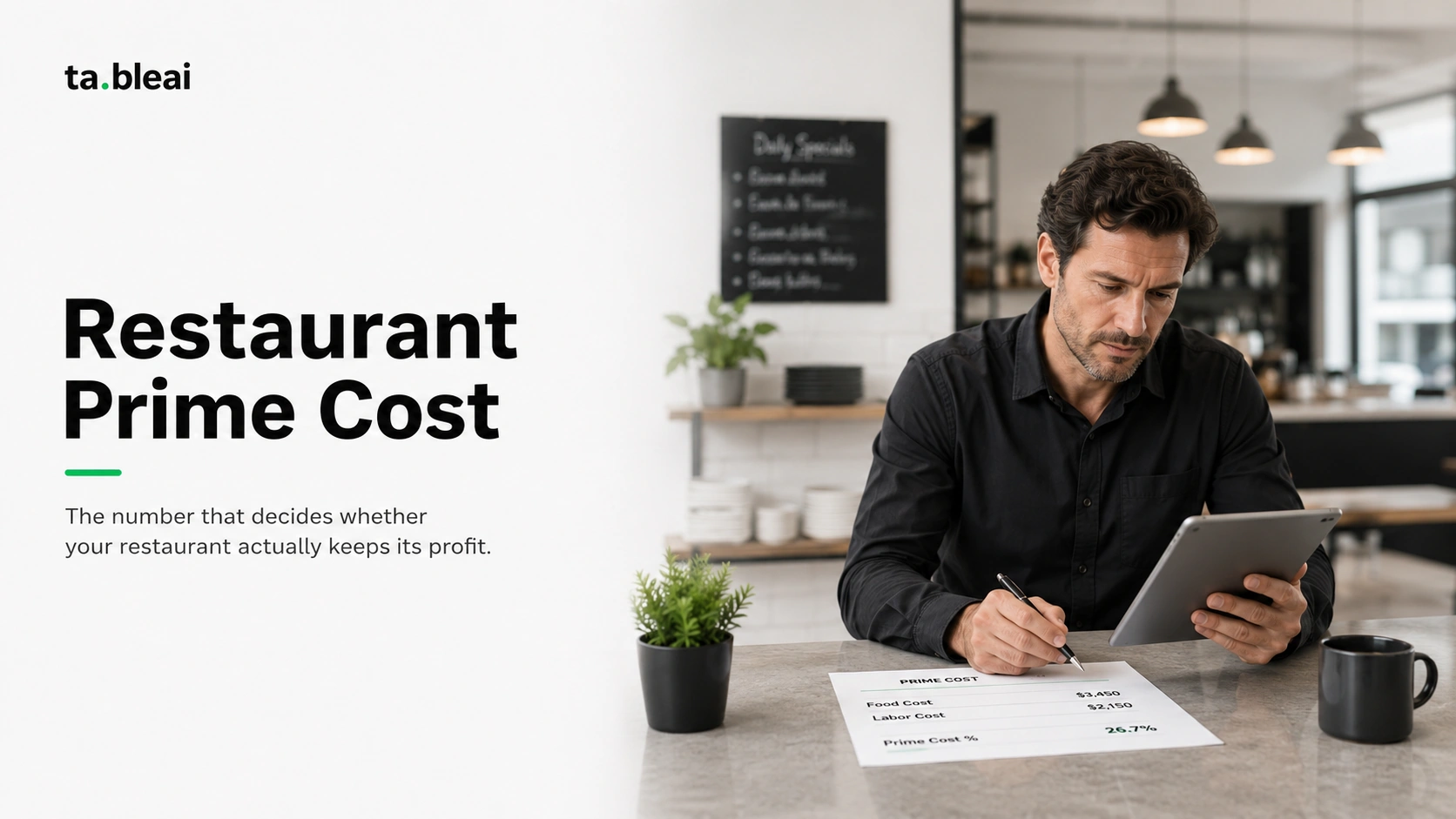
The benchmark most operators and consultants use for a healthy independent restaurant is 55-65% of revenue, but the right number for you depends on your format.
- Full-service / casual dining: 60-65%. Table service means more labor, so prime cost runs near the top of the range even with tight food cost.
- Quick-service / fast-casual: 55-60%. Lower labor per sale, but food cost sometimes higher on value menus.
- Cafes and coffee shops: often 55-62%. Great drink margins pull COGS down, but labor per transaction can be high if you're overstaffed in slow hours. There's more on this in the guide for cafes running lean on staff and stock.
- Bars / high-beverage: can dip toward 50-55% thanks to strong drink margins, if labor is controlled.
A widely used industry rule of thumb: keep prime cost at or under 65% and you have a realistic shot at profit. Push past 70% for three months straight and you are almost certainly losing money or about to. Below 55%, double-check you're not underpaying staff (turnover will punish you) or miscounting COGS.
Treat these as typical ranges, not laws. A rural spot with low rent survives a higher prime cost than a downtown lease that eats 12% of revenue before you buy a single tomato.
Why prime cost beats watching food cost or labor alone
Picture the trap most owners fall into. You obsess over food cost, get it down to a beautiful 28%, and feel like a genius. Meanwhile labor drifted to 38% because you kept the same staffing on slow nights. Your prime cost is 66% and you're bleeding, but the number you were staring at looked great.
The two costs trade against each other, which is exactly why neither one tells the truth alone.
- Buy pre-cut, pre-portioned ingredients and your food cost goes up but your labor goes down (less prep).
- Do everything from scratch and your food cost drops but your labor climbs.
- Cut a prep cook to save labor and watch waste rise because nobody's using trim properly, pushing food cost back up.
Any single-number focus lets the other cost hide. Prime cost closes the escape route. It doesn't care how you split the pie between ingredients and people; it only cares about the total slice they take. That's why experienced operators quote their prime cost ratio, not their food cost, when someone asks how the restaurant is really doing.
If you want to go deeper on each half, we break down the ingredient side in the restaurant food cost calculator guide and the people side in restaurant labor cost percentage: what's healthy and how to fix it. Prime cost is just those two added up and watched together.
How prime cost ties to your break-even
Prime cost is also the fastest way to sanity-check whether your restaurant can break even at all.
Break-even is the revenue where your total costs equal your total sales. Split costs into two buckets: your fixed costs (rent, insurance, base utilities, software, loan payments) and your variable costs, which are dominated by prime cost. Every dollar of sales pays its share of prime cost first, and whatever's left is your contribution toward fixed costs and profit.
Rough version with the earlier example:
Revenue:              $100,000
Prime cost (60%):     −$60,000
Left for everything:   $40,000
Fixed costs (rent, utilities, etc.): −$30,000
Profit:                $10,000
If your prime cost is 60%, then 40 cents of every dollar is available to cover fixed costs. Divide your monthly fixed costs by that 0.40 and you get your break-even revenue: $30,000 ÷ 0.40 = $75,000/month to break even. Let prime cost climb to 66%, and now only 34 cents of each dollar is left, so break-even jumps to $30,000 ÷ 0.34 = $88,000/month. Same restaurant, same rent, but you now need $13,000 more in sales every month just to reach zero.
And that is the part that catches owners off guard. A high prime cost doesn't just shrink profit, it moves your break-even further away, so you have to work harder for the same result. If you want to run the full calculation, the restaurant break-even calculator guide walks through it step by step.
How to lower prime cost without wrecking the place
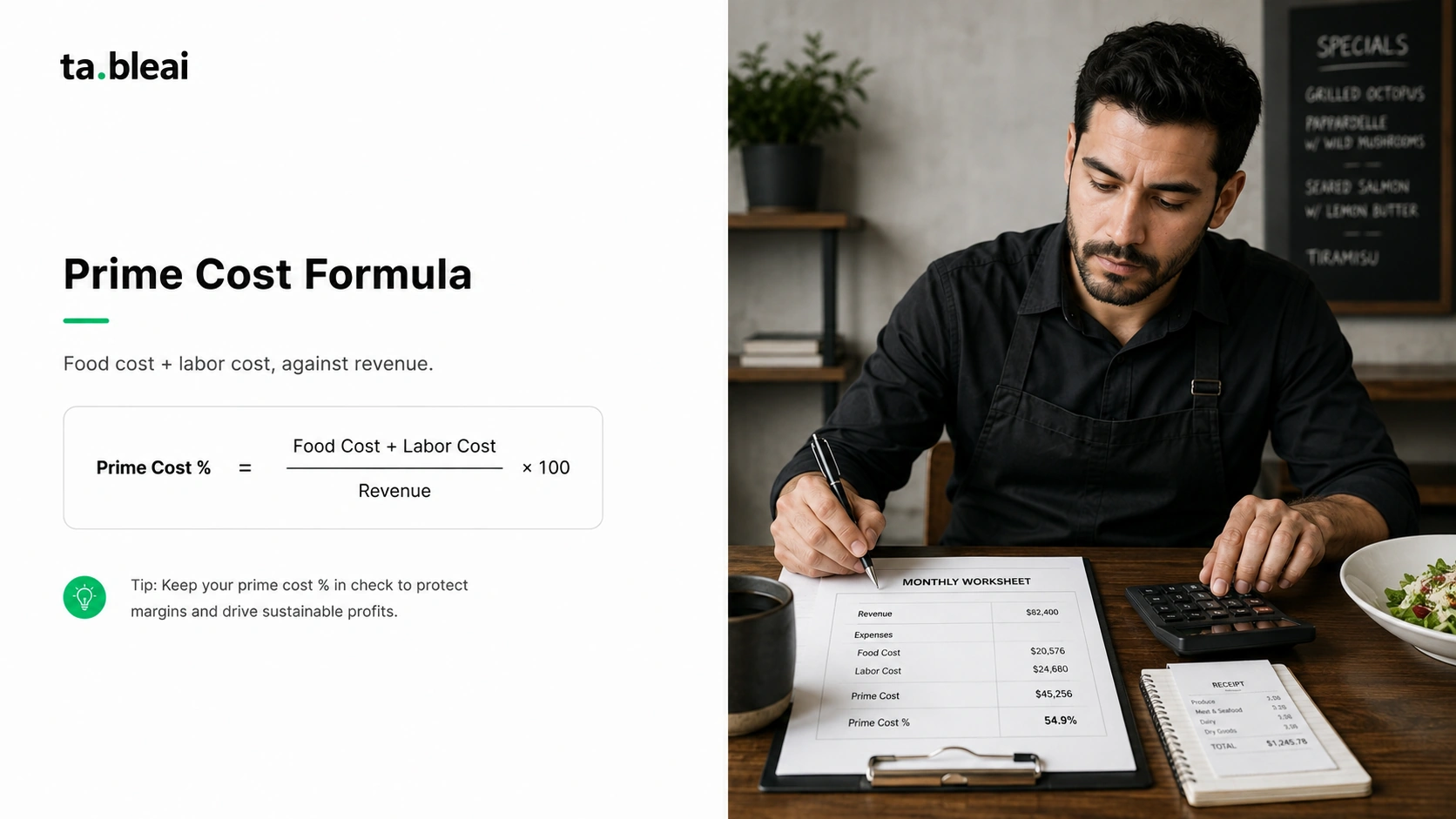
Lowering prime cost means squeezing two levers at once, carefully, because yanking either too hard breaks something.
On the COGS side
- Weigh portions randomly, mid-service. Portion drift is the quietest killer. A dish that was speced at 350g of protein creeps to 400g over six months and your cost jumps 14% at the same menu price.
- Track waste for one week. Weigh what hits the bin. Most kitchens throw out 8-15% of what they buy. Getting that to 5% is real money.
- Watch your top ten ingredient prices. Suppliers raise prices without announcing it. When a core input jumps 8% or more, either raise the menu price on dishes that use it or negotiate.
- Reconcile inventory to sales monthly. If 20 chickens got used but only 17 chicken dishes rang up, you have theft, waste, or over-portioning. Investigate.
On the labor side
- Schedule to actual demand, not habit. Pull your sales by day and hour. If Tuesday from 2-5pm does almost nothing, don't staff it like Friday night.
- Track sales per labor hour. Divide revenue by hours worked. When that number drops, you're overstaffed for the volume you're doing.
- Cross-train so fewer people cover more. A server who can run food and a cook who can prep salads means you schedule tighter without leaving gaps.
- Cut overtime before you cut people. Overtime is prime cost inflation hiding in plain sight.
The mistake is treating these as one-time fixes. Prime cost drifts back up the moment you stop watching, because portions creep, prices rise, and schedules loosen on their own. The win is a daily habit, not a quarterly panic. If you suspect it's already too late, the warning signs are laid out in how to know if your restaurant is losing money.
How to track prime cost without a finance degree
You don't need accounting software to watch prime cost. You need two numbers logged consistently: what you spent on ingredients and drinks, and what you spent on labor, both against your sales.
Most owners fail here not because the math is hard but because logging it daily is boring and easy to skip. Then the month closes and the numbers are guesses.
This is the gap TableAI is built for. It's a WhatsApp-based tracker for small independent restaurants, not a POS, so it doesn't process cards or print receipts. You keep your existing payment setup, whether that's cash, a mobile wallet, or a standalone card reader. You just text it what happened: "sold 80 today," "got 20kg chicken," "two staff in today." It logs sales, ingredient inventory with low-stock alerts, staff attendance, and your supplier phone numbers. Every morning at 7am it sends a briefing with yesterday's numbers and what's running low, so a two-point drift in food or labor shows up in days, not at quarter-end. Pricing is flat, around $29-49/month, and it's free during early access. You can see the full pricing here.
The tool doesn't fix your prime cost. Watching the number daily and acting on it does. TableAI just makes the watching a five-minute habit instead of a Sunday-afternoon project you keep postponing.
Frequently asked questions
What is prime cost in a restaurant?
Prime cost is your total cost of goods sold (food plus beverage) added to your total labor cost, including wages, salaries, and payroll taxes. It captures the two biggest controllable expenses in one number, usually measured as a percentage of revenue.
What is a good prime cost percentage for a restaurant?
A healthy independent restaurant commonly runs a prime cost of about 55 to 65 percent of revenue. Full-service restaurants sit near the higher end because of table service labor, while quick-service and cafes can land lower.
How do you calculate prime cost?
Add your cost of goods sold to your total labor cost, then divide by total revenue and multiply by 100. For example, 32,000 dollars COGS plus 28,000 dollars labor on 100,000 dollars revenue is a 60 percent prime cost.
Why does prime cost matter more than food cost alone?
Food cost and labor cost can be traded against each other, so looking at either one alone hides the real picture. Prime cost combines both, which stops you from congratulating yourself on cheap ingredients while labor quietly eats the same margin.
How can I lower my restaurant prime cost?
Lower prime cost by tightening portions and waste on the COGS side and matching staff schedules to real demand on the labor side. Track both daily so a two or three point drift shows up in days instead of at the end of the quarter.
Related reading: