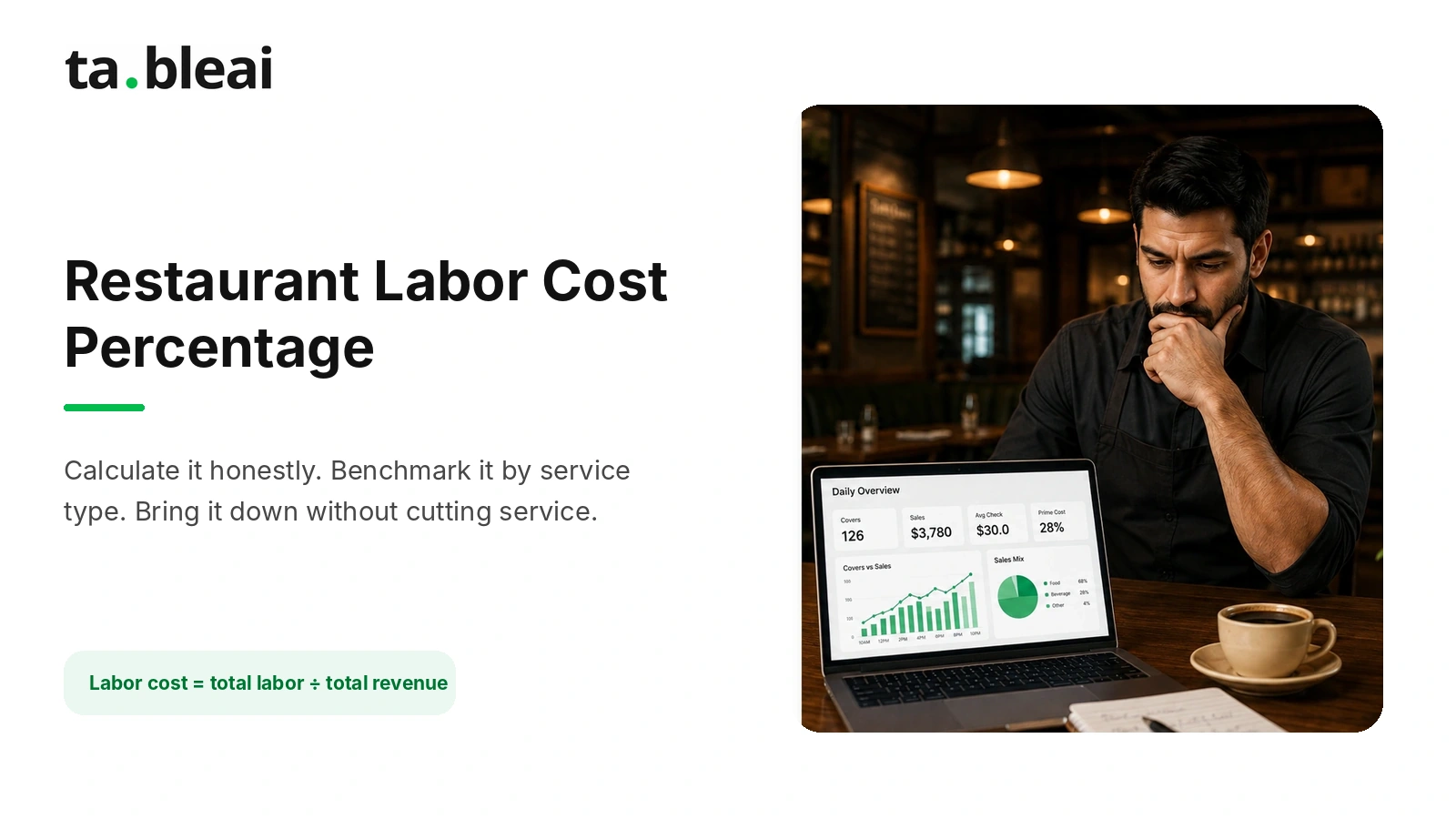
Your restaurant labor cost percentage is the number that tells you whether your schedule is paying for itself or quietly eating your profit. It is total labor divided by revenue, times 100, and for most restaurants a healthy figure sits somewhere around 25 to 35 percent depending on how you serve. That range is the whole game. Drift a few points over it for a few months and the money that should have been profit is already gone, spent on hours that never turned into sales.
Most owners feel labor pain long before they measure it. Payroll feels heavy, the schedule feels bloated, but nobody has the actual number. Here is how to calculate it, what a healthy range looks like, and how to bring it down without your guests ever noticing.
What labor cost percentage actually means
Labor cost percentage is your total cost of employing people, expressed as a share of the revenue those people helped produce. It is one of the two big controllable numbers in a restaurant. Food is the other.
The formula:
Labor Cost % = (Total Labor Cost ÷ Total Revenue) × 100
The trap is in the phrase "total labor cost." A lot of owners only count hourly wages and get a number that looks great and means nothing. Total labor is everything it costs to have staff on the payroll:
- Hourly wages and salaries
- Overtime pay
- Payroll taxes
- Benefits and insurance
- Paid time off, bonuses, and any staff meals you cover
Leave those out and you might think you are running at 22 percent when the real figure is 31 percent. The benchmarks below assume the full, loaded number.
How to calculate labor cost for a restaurant: a worked example
Say last month your revenue was $60,000. Here is what you actually spent on people:
Hourly wages ............. $14,200
Salaries (you + manager) . $4,000
Overtime ................. $1,100
Payroll taxes ............ $1,600
Benefits + insurance ..... $900
--------------------------------
Total Labor Cost ......... $21,800
Now run the formula:
Labor Cost % = ($21,800 ÷ $60,000) × 100 = 36.3%
So this restaurant is at 36.3 percent. If it is a full-service place, that is at the high edge of normal and worth watching. If it is quick-service, it is a problem that is costing real money every week.
Notice what happens if you had only counted the $14,200 in hourly wages: you would have calculated 23.7 percent and felt fine. That gap, almost 13 points, is entirely money you were spending but not counting. This is why "labor cost of sales" only means something when the labor number is complete.
One more note on the denominator. Use total revenue, not just food sales. Your team pours the drinks and rings up everything, so all of it belongs in the calculation. Dividing labor by food sales alone inflates the percentage and makes every benchmark look scary for no reason.
What is a healthy labor cost percentage?
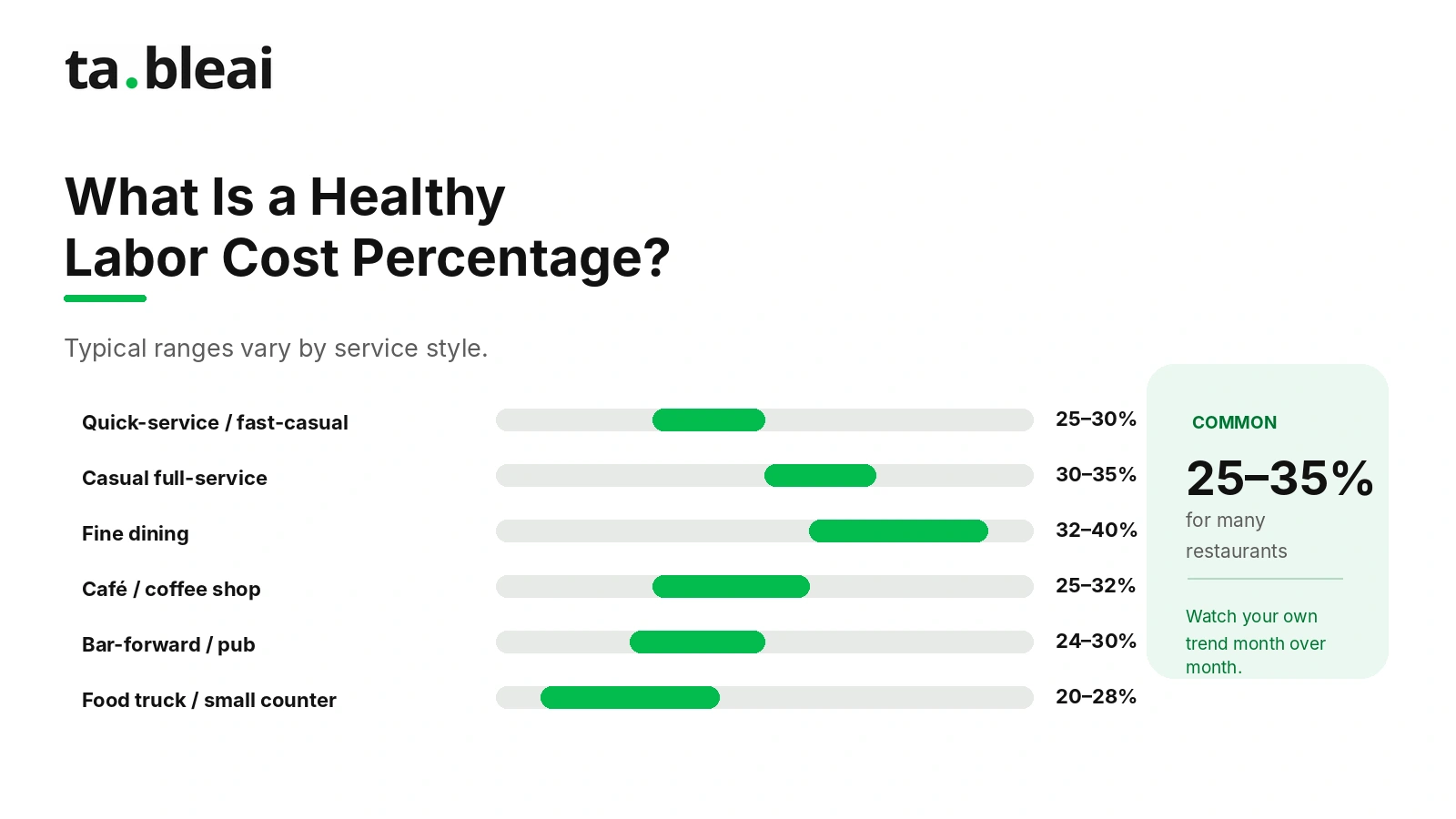
There is no single magic number, but the commonly cited ranges cluster by service style. More hands-on service means more labor, and the menu price is supposed to account for it.
- Quick-service / fast-casual: 25-30% (leaner crews, faster turns)
- Casual full-service: 30-35% (servers, hosts, more coverage)
- Fine dining: 32-40% (high service ratio, skilled kitchen)
- Café / coffee shop: 25-32% (depends heavily on food vs. drink mix)
- Bar-forward / pub: 24-30% (drinks carry the margin)
- Food truck / small counter: 20-28% (tiny crew, no floor to staff)
Treat these as typical, not gospel. A tipped model, a heavy salaried management layer, or a region with different wage floors will shift your target. The useful move is to pick the range for your format, then watch your own trend against it month over month.
Sitting above your range for three months straight means something is wrong with scheduling, not with the benchmark. Sitting well below it can be good, or it can mean you are understaffed and burning out the people you have while service quietly slips.
The things that quietly push labor cost up
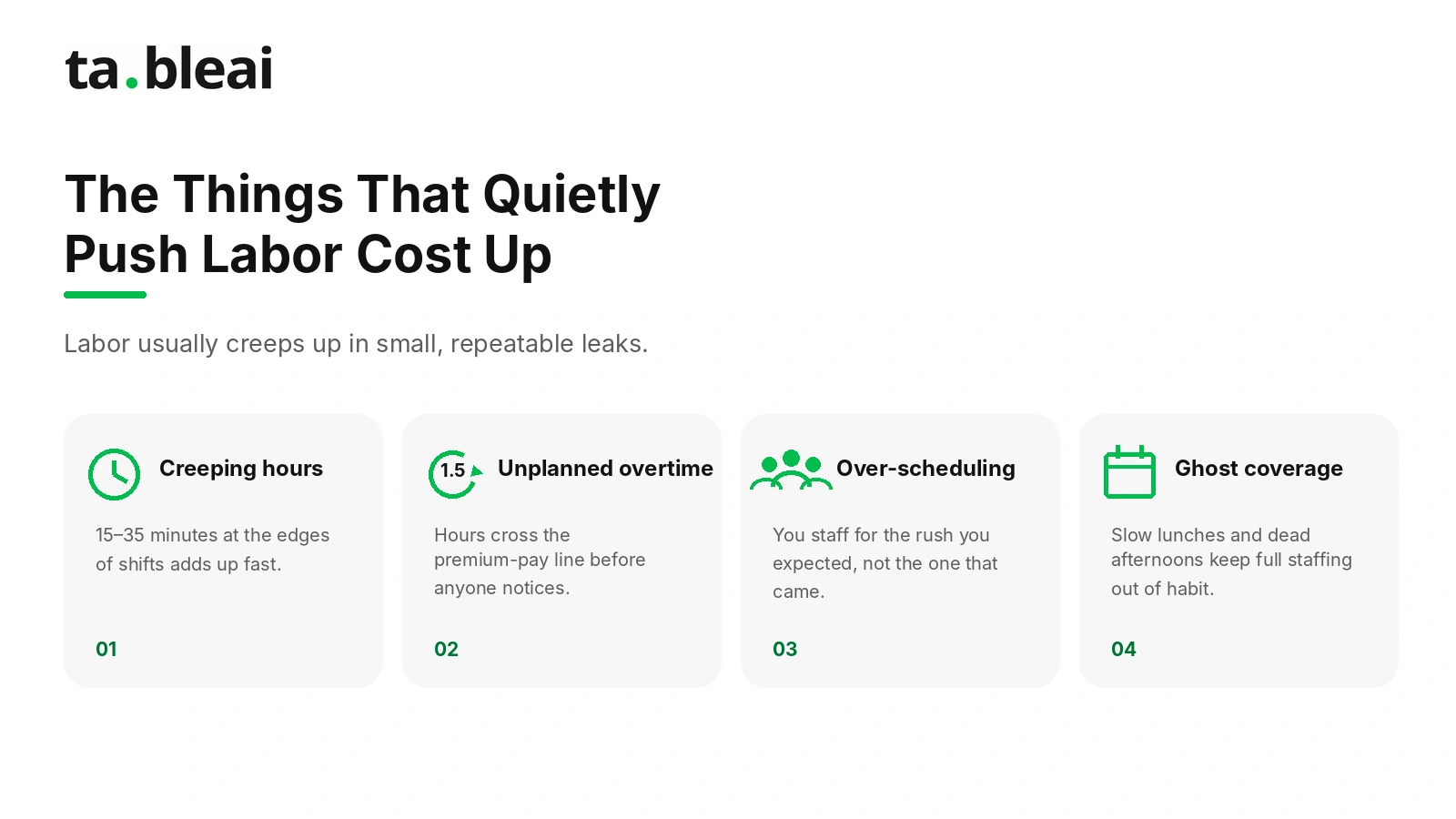
Labor rarely blows up in one dramatic week. It creeps. Here is where the creep comes from.
Creeping hours
Shifts that were four hours become five. Someone clocks in fifteen minutes early to "set up" and clocks out twenty minutes late to "close out." None of it feels like much. Multiply fifteen wasted minutes per shift across six staff, six days a week, and you are paying for roughly nine extra labor hours every week that produced nothing.
Fix: Set clear shift start and end times and hold to them. If prep genuinely needs an extra hour, schedule that hour on purpose instead of letting it leak in unmeasured.
Overtime you didn't plan
Overtime is the most expensive labor you buy, often at 1.5x, and it usually shows up because nobody was watching hours mid-week. By Thursday two people are already near the overtime line, and Saturday's rush pushes them over at premium rates.
Fix: Check accumulated hours every Wednesday or Thursday, not on payday. If someone is trending toward overtime, adjust the back half of their week before the expensive hours happen.
Over-scheduling for a rush that doesn't come
You staff five for a Friday that turns out slow, and three of them stand around. Or you keep the whole crew until close when the last table left an hour ago. Coverage feels safe, but you are paying for insurance against a rush that already passed.
Fix: Schedule to demand. Look at what actually happened on the last four Fridays by hour, not what you fear might happen, and build the schedule around the real pattern. Send people home when the room empties.
Ghost coverage on slow shifts
Slow lunches and dead mid-afternoons are where labor percentage goes to hide. Revenue is thin, but you have kept full staffing out of habit. The percentage on those hours is brutal because the denominator is tiny.
Fix: Trim the slowest hours first. A single overlapping shift removed from a dead Tuesday afternoon can move your monthly number more than you would expect.
How to bring labor cost down without cutting service
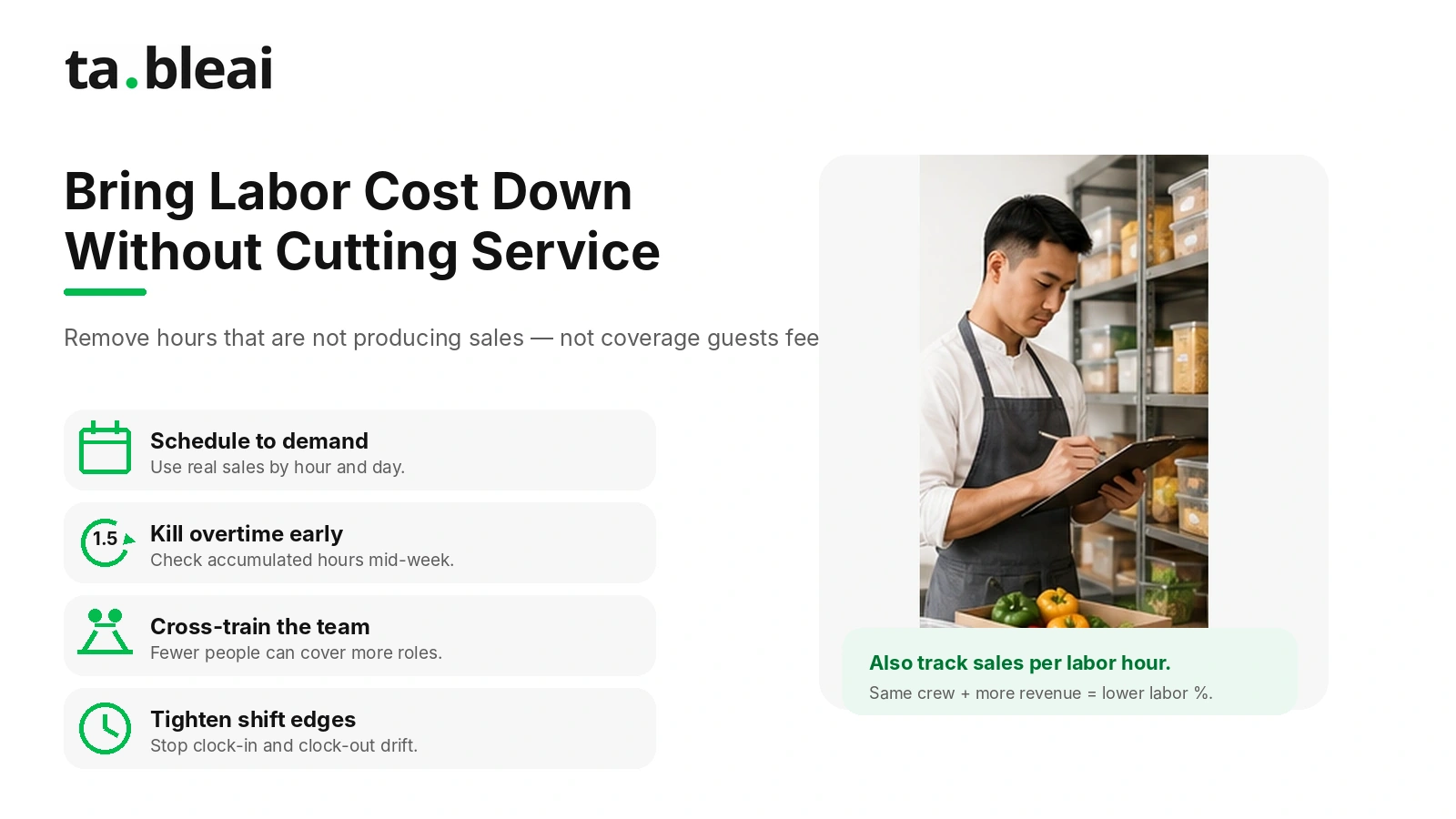
The wrong way to fix labor is to yank a server off the floor during a rush and watch your reviews tank. The right way is to remove hours that were not producing sales in the first place. Guests never feel that.
1. Schedule against demand, not habit. Pull your sales by hour and day. Staff up for the peaks, thin out the valleys. Most restaurants are over-staffed in the slow middle of the day and under-staffed at the edges of the rush.
2. Kill overtime before it starts. Watch hours mid-week. Premium pay for hours that a small shuffle could have avoided is the easiest money you will ever save.
3. Cross-train your people. When a server can run food, a cook can prep and plate, and a cashier can bus, you cover the same room with fewer bodies. Cross-trained crews absorb a no-show without you calling in a fourth person on overtime.
4. Tighten the edges of every shift. Clock-in and clock-out drift is invisible and constant. Once you set a firm start and end time and make sure the crew knows it, the leak closes on its own.
5. Match prep labor to real volume. Prepping for a Friday that never gets busy pays kitchen hours to make food you throw out. Prep to the pattern you actually see.
6. Raise sales per labor hour, not just cut heads. Sometimes the answer is not fewer people but more revenue from the same crew: a faster table turn, a well-placed upsell, a tighter counter flow. Same labor dollars, bigger denominator, lower percentage.
A useful metric to track alongside the percentage is sales per labor hour: total revenue divided by total hours worked. It tells you whether each hour on the schedule is pulling its weight, which is often more actionable than the percentage alone.
Labor cost is only half the picture: prime cost
Labor cost percentage on its own can lie to you. You can run lean labor and still lose money if food cost is out of control, or carry higher labor and be fine because your food cost is tight. The number that ties them together is prime cost.
Prime Cost = Total Labor Cost + Total Food & Beverage Cost
Prime Cost % = (Prime Cost ÷ Total Revenue) × 100
Prime cost is your two biggest controllable expenses in one figure, and it is the number seasoned operators actually manage to. A commonly cited target is keeping prime cost under about 60 to 65 percent of revenue. Above that and there is often not enough left to cover rent, utilities, and everything else before profit.
Back to the earlier example. Labor was $21,800 on $60,000 of revenue. Say food and beverage cost was $19,000 that month:
Prime Cost = $21,800 + $19,000 = $40,800
Prime Cost % = ($40,800 ÷ $60,000) × 100 = 68%
Sixty-eight percent is over the line. The labor number alone (36 percent) looked merely high; prime cost shows the fuller squeeze. That is why you read the two together. For the food side of the equation, our restaurant food cost calculator guide walks through calculating and controlling COGS, and the full breakdown of restaurant prime cost shows how to manage both levers at once.
How to track this without a finance degree
The math is easy. Doing it consistently, every week, is the hard part, and it is where most owners fall off. You need two running numbers: what you sold and what you paid in hours. If both live in your head or on scattered receipts, you will only calculate labor when it is already a crisis.
TableAI handles the tracking side over WhatsApp. You text in your daily sales ("sold 90 today") and your staff attendance as it happens, and every morning at 7am it sends a briefing with yesterday's numbers and what to expect. It is not a POS and it does not run payroll, but it keeps the two inputs you need for this calculation in one place, updated daily, so the labor math is a five-minute check instead of a month-end scramble. If most of your day already runs through your phone, here is how owners run a small restaurant from a phone without a back office.
If you are comparing dedicated scheduling software, it helps to know what you actually need first. A pure scheduler like 7shifts is built for larger teams with complex rotas; our look at 7shifts for small restaurants covers when that is overkill. And if you run a counter-service spot, the labor targets and tactics differ enough that our quick-service guide is worth a read. When labor and food are both drifting at once, the warning signs that a restaurant is losing money usually show up in these exact numbers first.
Frequently asked questions
How do you calculate restaurant labor cost percentage?
Divide total labor cost for a period by total revenue for the same period, then multiply by 100. Total labor should include wages, salaries, payroll taxes, and benefits, not just hourly pay.
What is a healthy labor cost percentage for a restaurant?
A commonly cited healthy range is roughly 25 to 35 percent of revenue, depending on service type. Quick-service tends to sit lower, around 25 to 30 percent, while full-service runs closer to 30 to 35 percent and fine dining can trend higher because of heavier staffing.
What is the difference between labor cost percentage and prime cost?
Labor cost percentage measures only staffing against revenue, while prime cost adds food and beverage costs to labor. Prime cost is the fuller picture of controllable spend, and many operators aim to keep it under about 60 to 65 percent of revenue.
How can I reduce restaurant labor costs without cutting service?
Schedule to demand instead of habit, cut overtime by watching hours mid-week, cross-train staff so fewer people cover more roles, and tighten shift start and end times. These trim hours where they are not producing sales rather than removing coverage guests notice.
Should labor cost percentage be based on total sales or just food sales?
Base it on total revenue, including food, beverage, and any other sales, because your whole team supports all of it. Using only food sales inflates the number and makes benchmarking against typical ranges misleading.
Bottom line
Labor is one of the two numbers that decide whether a restaurant survives, and unlike rent, you can move it every single week. Calculate it honestly with the full loaded cost, know the range for your service type, and watch the trend instead of one scary month. Then read it next to food cost as prime cost, because that pair is the real story.
Most of the drift comes from creeping hours, unwatched overtime, and staffing for rushes that never arrive. None of that requires cutting service to fix. It requires seeing the hours before they turn into payroll, which is really just a habit of tracking. Find the system that makes that habit painless, and check TableAI's pricing if you want the daily numbers to text themselves to you every morning.
Related reading: