Most restaurants that fail didn't fail overnight. They bled slowly for six to twelve months, and the owner noticed too late.
The problem isn't always dramatic. There's no single terrible day. Sales dip slightly, food costs creep up, one manager gets sloppy — and the trends compound quietly until the bank statement is the wakeup call.
Here are five warning signs that show up before the numbers get scary. Catch them early and you have time to fix things. Miss them and you're playing catch-up on a business that's already sliding.
1. Same-day-of-week sales are dropping and you didn't notice
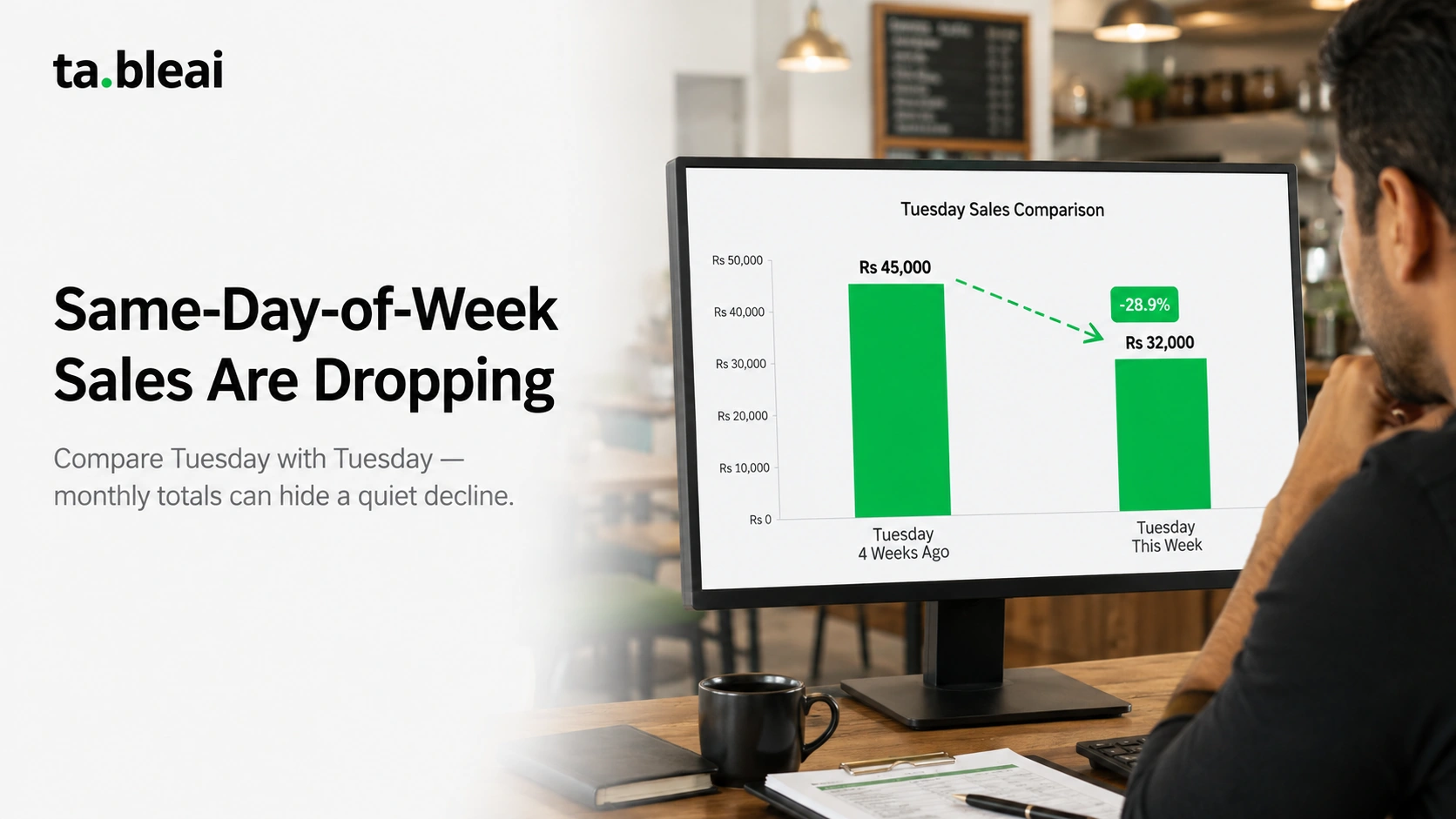
What to watch: Compare each day of the week to the same day four weeks ago.
Total monthly revenue can look flat while individual days are quietly dying. A restaurant might do the same $120,000 in July as June, but if Tuesdays used to do $4,500 and now do $3,200, and Saturdays picked up the slack — something changed about your Tuesday business. Maybe a competitor opened. Maybe your Tuesday lunch customer moved. Maybe your Tuesday cook got worse.
You won't catch this looking at monthly totals. You catch it comparing this Tuesday to last Tuesday to the Tuesday before.
Rule of thumb: If any day of the week drops 15%+ over three weeks and doesn't recover, investigate immediately. Don't wait for the monthly report — by then you've lost a month of revenue and don't know why.
How to track this: Log daily sales, either in a notebook or via TableAI, and compare same-day-of-week each week. If the number is trending down and you don't know why, ask the customers who normally come that day.
2. Food cost percentage crept above 32% and you didn't adjust menu prices
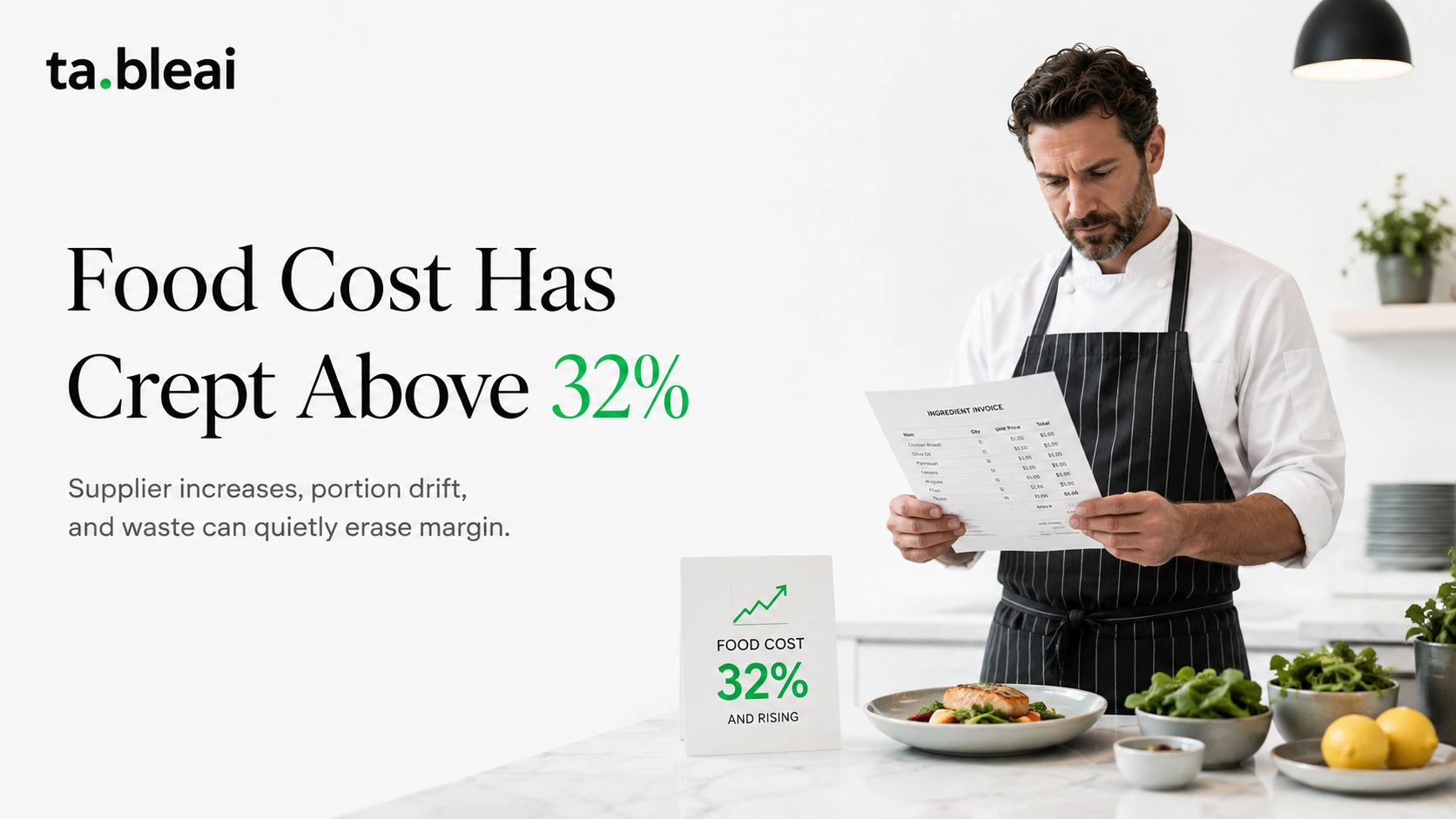
What to watch: Cost of goods sold (COGS) as a percentage of revenue.
A healthy restaurant runs 28-32% food cost. Above 35%, you're bleeding. Above 38%, you're in trouble.
Food costs creep up quietly for three reasons: supplier prices went up and you didn't raise menu prices, portion sizes drifted larger, or waste increased (staff throwing things out, over-prep, spoilage).
The math: Calculate food cost monthly. Take total food purchases divided by total food revenue. If you spent $40,000 on ingredients this month and did $120,000 in food revenue, your food cost is 33%. That's the edge of acceptable — one bad supplier month and you're at 36%.
What to do: Raise menu prices by 5-8% every 12-18 months as a matter of routine. Not when you're desperate — routinely. Customers accept it if you don't panic. Also, weigh portions monthly to make sure cooks haven't drifted heavier over time.
3. Labor cost is climbing but the schedule looks the same
What to watch: Total wages as a percentage of revenue, week over week.
Restaurants aim for 25-30% labor cost. Above 35%, something's off.
The tricky version: labor cost creeps up not because you added staff, but because you added hours quietly. Someone showed up early. Someone stayed late. A shift got covered by two people instead of one because there was a rush. Nothing dramatic in any single week — but sum of eight weeks, you're paying 12% more in wages for the same schedule.
The check: Every week, total hours worked. Compare to hours scheduled. If the delta is more than 10%, you're either overspending on overtime or your schedule doesn't match reality.
What to do: Track scheduled vs actual hours. If a specific person is consistently over their scheduled hours, ask why. If it's a specific shift, adjust the schedule.
4. You're running out of ingredients mid-service more than once a month
What to watch: Stock-out events during service.
Every time you run out of an ingredient mid-service, you lose sales you would have made. Third customer in a row wants chicken — you're out — they leave. That's $8 gone, plus a customer who might not come back.
If this happens more than once a month, your ordering isn't matching your demand. Either you're guessing on quantities (usually low, because over-buying feels like waste) or you don't have a system for tracking what's low before it's out.
The math: A busy QSR loses roughly $500-$1,500 per stock-out event depending on the item. Four stock-outs a month = $2,000-$6,000 in lost revenue. Over a year, that's enough to cover a decent tracking system many times over.
What to do: Track daily inventory of your top 10 ingredients. Set reorder points ("when chicken drops below 5kg, buy more"). Get supplier phone numbers stored somewhere you can call them in 5 seconds.
5. You don't know your best or worst day this week without checking
What to watch: Your own awareness.
If your business is $40,000/month and you don't know off the top of your head:
- Was yesterday better or worse than last week?
- What's your best day of the week usually?
- Are you trending up or down this month?
- Which supplier bill is due this week?
...you're running on vibes. Restaurants that fail almost always have owners running on vibes. Restaurants that survive have owners who know the numbers.
The good news: you don't need a fancy system. A notebook works. A daily 60-second habit of writing down yesterday's sales, stock levels, and any issues works. Or a tool that does this automatically.
What to do: Every morning before opening, know three numbers — yesterday's revenue, this week vs last week, and what's currently low on stock. If you don't know, find out before you do anything else.
What all five warning signs share
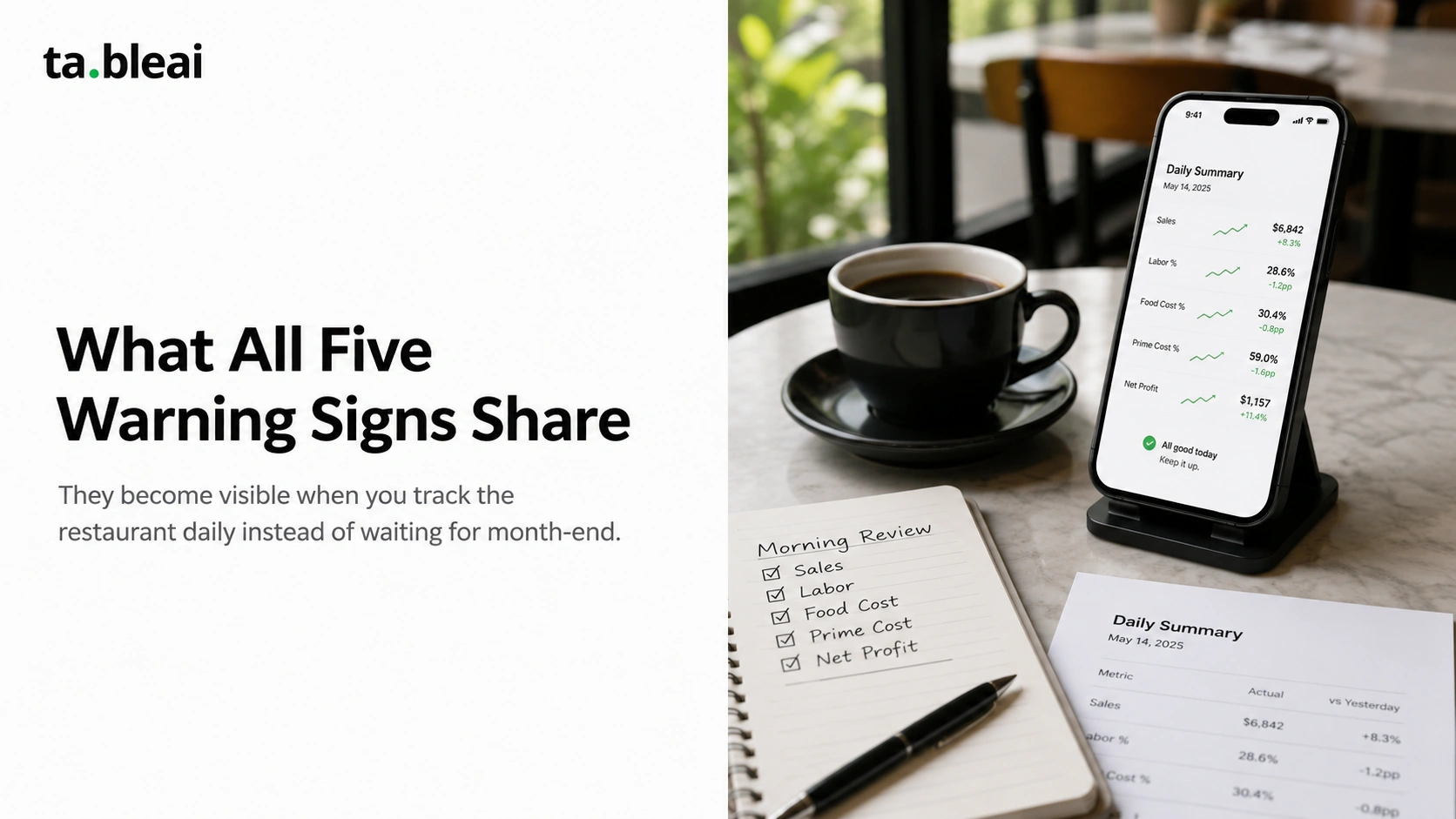
They're all invisible without daily tracking. Monthly reports come too late — by the time you see July's food cost hit 38%, August is already halfway lost.
The restaurants that catch these signs early do one of three things:
- Manual daily log — notebook, spreadsheet, or a smart friend. Takes 5 minutes a day. Free.
- Full POS with reporting — Toast, Square, Lightspeed. Costs $250-1,500/month. Overkill for most independents.
- WhatsApp-based tracking — text daily numbers, get automatic patterns and alerts. This is what TableAI does, priced somewhere between manual and full POS.
Pick whichever fits your budget and habits. The important thing is that you're tracking daily — not monthly, not quarterly. The trends that kill restaurants show up in weeks, not months.
Bottom line
Restaurant failures aren't usually about one bad decision. They're about small negative trends compounding for six months while nobody was watching.
The five signs above show up early enough to fix. Watch them daily and you'll catch problems while they're small. Watch them monthly and you'll catch them after they've done real damage.
Related reading:
- The Restaurant Food Cost Calculator Guide — how to calculate and control COGS- Why the Morning Briefing Matters — the 7am habit that catches problems early