If you run a small cafe, inventory management comes down to one honest question: will you run out of milk mid-rush, or will you throw out pastries at close? Good stock control keeps you off both extremes. The system below uses a short daily close and a fuller weekly count. It is built for a small owner-run shop, not a chain with a warehouse.
Here is the short version. Track the focused list of items that actually matter (beans, milk, syrups, pastries, cups). Set a par level for each, meaning the minimum you want on hand before the next delivery. Count fast-moving perishables daily at close, do a full count weekly, reorder anything at or below par, and rotate stock FIFO so older product sells first. That is the whole system. The rest of this guide makes it concrete.
Start with our free inventory spreadsheet, which includes a fictional café example for coffee beans, milk and cups. Use your own currency and consistent count units.
What to actually track in a small cafe
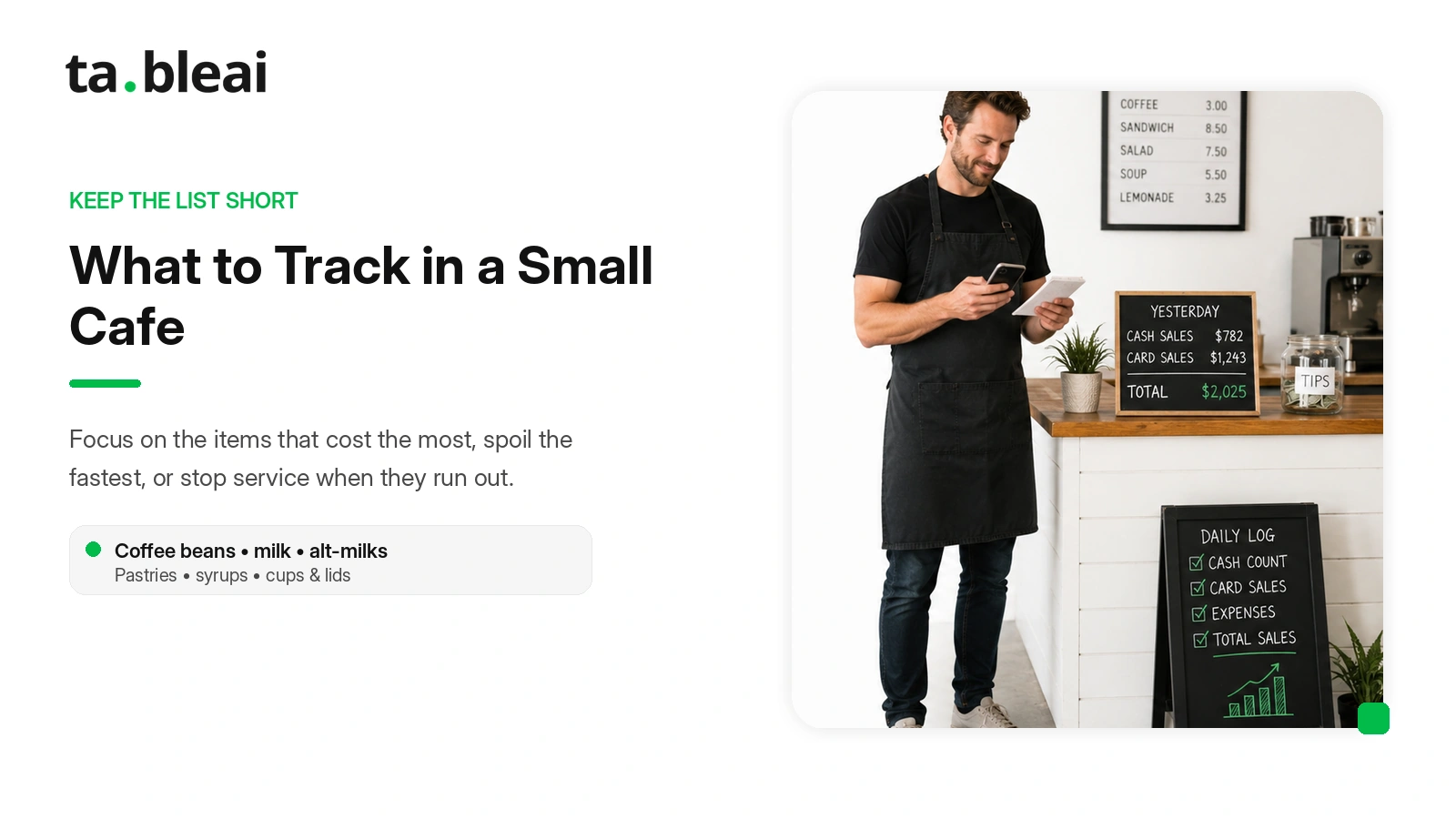
The mistake most owners make is trying to track everything. You do not need to count every teaspoon and napkin. You need to watch the items that either cost the most, spoil the fastest, or stop service when they run out. For a typical cafe that is a short list:
- Coffee beans — your highest-value ingredient by weight. Track by kilos or bags. Note each blend or single origin separately if you carry more than one.
- Milk and alternative milks — dairy, oat, almond, soy. These spoil fast and vanish during a rush. The most common cause of a lost sale in a cafe is running out of oat milk on a Saturday.
- Syrups and sauces — vanilla, caramel, chocolate. Long shelf life, but easy to lose track of and annoying to run out of mid-order.
- Pastries and food ingredients — croissants, muffins, sandwich components, anything with a short life. This is where most of your waste hides.
- Packaging — cups, lids, sleeves, takeaway bags, napkins. Cheap per unit, but running out of 12oz lids stops takeaway service cold.
- Retail and extras — bagged beans for resale, bottled drinks, tea. Track if you sell them; skip if you do not.
That is usually 15 to 25 line items. Write them down once, in the order you would walk your shelves and fridge, and that list becomes your count sheet.
Par levels and reorder points
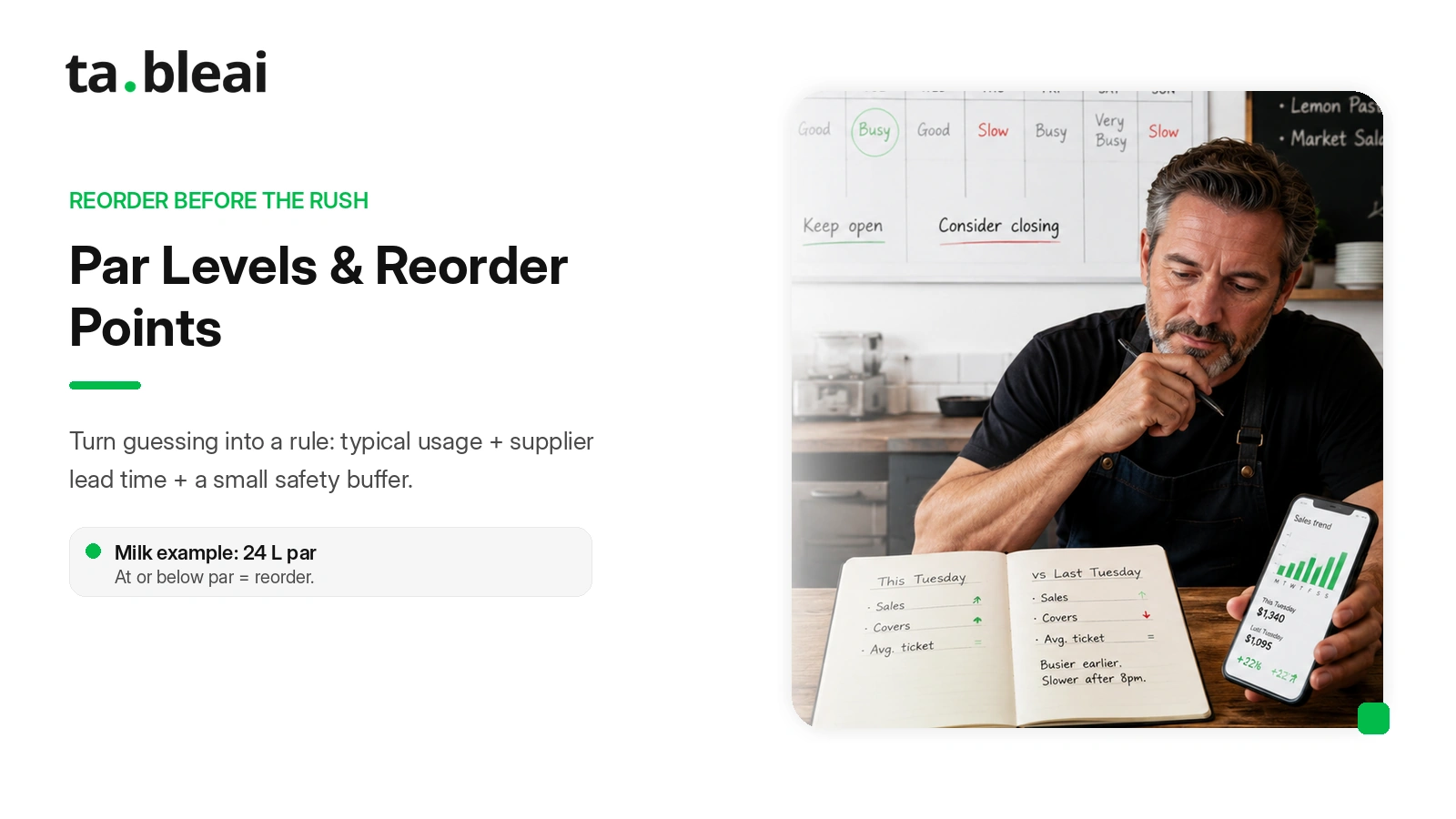
A par level is the minimum quantity of an item you want on hand to reach your next delivery without running out. It is the single idea that turns inventory from guessing into a rule.
Set each par level from three things:
- Typical usage between deliveries — how much you actually go through.
- Supplier lead time — if beans take three days to arrive, your par has to cover three days.
- A safety buffer — a little extra for a busy weekend or a late delivery.
A worked example for milk: you use about 8 liters a day, your dairy delivery comes every 2 days, and you want a 1-day buffer. Par level = 8 × (2 + 1) = 24 liters. When your count drops to 24 liters or below, you reorder.
Strictly speaking, textbook inventory keeps these as two separate numbers: the par is the level you top back up to, and the reorder point is the lower trigger that tells you to place the order. For a small cafe counting once a day, that split is more precision than you need, so this system deliberately simplifies and treats your par as the reorder trigger. Count, hit par, reorder. If you ever move to less frequent counts, that is when the two numbers start to pull apart.
| Item | Daily use (typical) | Delivery cycle | Par level | Reorder when |
|---|---|---|---|---|
| Dairy milk | 8 L | Every 2 days | 24 L | ≤ 24 L |
| Oat milk | 4 L | Weekly | 32 L | ≤ 32 L |
| House blend beans | 3 kg | Twice weekly | 12 kg | ≤ 12 kg |
| Croissants | 30 units | Daily (fresh) | 36 units | ≤ order for tomorrow |
| 12oz cups | 200 units | Weekly | 1,400 units | ≤ 1,400 units |
These numbers are illustrative, and yours will differ by volume and supplier. Some rows carry a day of buffer and some sit right at bare usage, which is fine for a table meant to show the method rather than hand you exact figures. The point is the rule: set a par, then let "at or below par means reorder" replace the daily worry of do we have enough?
FIFO: the rule that kills waste
FIFO means first in, first out — you use the oldest stock before the newest. In a cafe this is mostly physical habit:
- When new milk arrives, put it behind the existing cartons, not in front.
- Date open bags of beans and opened syrup bottles with a marker.
- Rotate pastries so yesterday's display product is used or discounted first.
- Store deliveries in the same order every time so "oldest is at the front" is automatic.
FIFO is one of the biggest levers against spoilage waste, because perishables expire on a clock whether you sell them or not. A cafe that counts stock but does not rotate it will still throw money in the bin. For more on trimming spoilage across a food business, see our guide on how to reduce food waste in a restaurant.
A short daily close routine
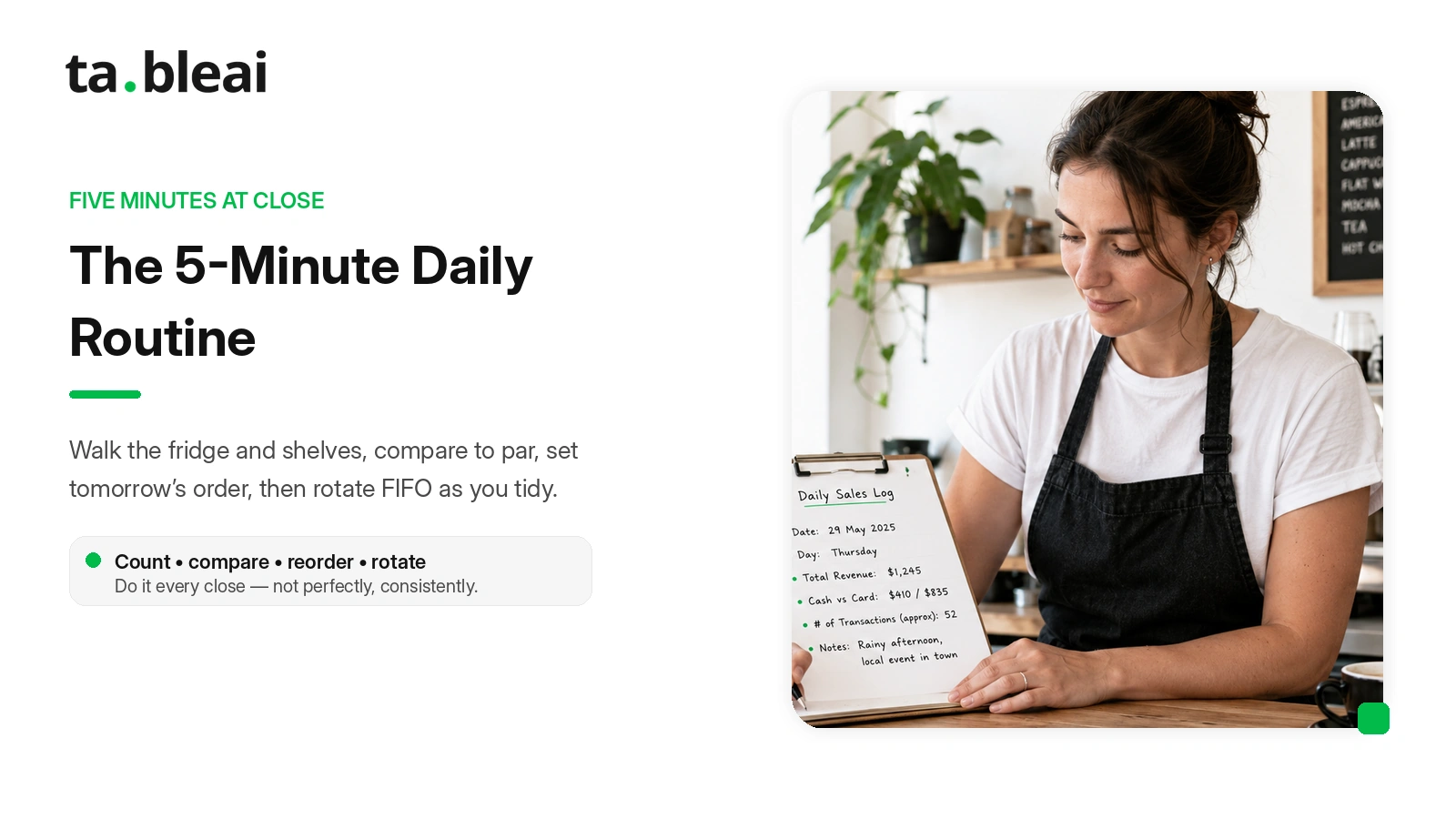
Do this at close, when you already know what the day looked like. It is a walk, not a spreadsheet session.
- Walk the fridge and shelves in list order. Milk, alt-milks, pastries, prepped food. These are your fast movers.
- Note anything at or below par. Mark it on the sheet or text it to whoever orders.
- Log the day's rough sales or cups pulled. Even "sold about 180 today" tells you tomorrow's milk and pastry pull.
- Set tomorrow's pastry and fresh-food order. Base it on today's actual sales, not habit. This is where daily waste gets cut.
- Rotate for FIFO as you tidy. Fresh behind old, date anything you opened.
The discipline that matters is doing it every close, not doing it perfectly.
The weekly count
Once a week, on your slowest morning, do a full count of everything on your list — including the slow non-perishables you skip daily (cups, lids, syrups, retail). This weekly count is what catches quiet drift: the syrup you are somehow always low on, the size of cup that keeps running out. Use the full count to adjust par levels up or down based on what really happened.
How this ties to food cost and waste
Inventory is not paperwork. It is the clearest window into where money leaks. Two numbers come almost free once you count consistently:
- Waste is what you counted, did not sell, and threw out. If you log daily counts and daily sales, your spoilage is simply what is missing that no sale explains. Watching pastry waste for two weeks usually cuts the next order before you do anything else.
- Food cost is what your beans, milk, and ingredients cost as a share of sales. Food cost varies widely by menu, region and pricing. Treat any benchmark as a starting point, not a target handed down from on high. You cannot calculate it at all without knowing what you used, and knowing what you used is inventory.
Count consistently for a month and you stop guessing. You order to actual demand, you rotate so less spoils, and both your waste and your food cost drift down on their own. For a broader take on running lean stock in a small food business, see restaurant inventory for a small business.
Paper, spreadsheet, or an app?
Any of the three works. The tool is not what makes inventory work. Consistency is. Pick the one you will actually touch every day.
- Paper count sheet. Free, fast, no learning curve. Print your item list with par levels, keep it on a clipboard by the fridge. The weakness: no trends, no alerts, and no easy way to compare this Tuesday to last Tuesday.
- Spreadsheet. Free and structured. Good if you are comfortable in Sheets and one person owns the file. It gets fragile the moment two people need to update it, and phone data entry is tedious.
- A tool that tracks it for you. Helpful when you want low-stock alerts and trends without opening yet another app. If you already live in WhatsApp, a chat-based tool like TableAI for cafes lets you text "got 20L oat milk" or "down to 4kg beans" and it logs the count, then brings yesterday's numbers and recorded low-stock items together in a morning briefing. It is not a POS and does not process payments, so you keep your existing setup. It just tracks the stock, sales, and staff side by phone. Pricing is flat and it is free during early access; see pricing.
Where TableAI is not the fit: if you want automatic depletion from POS scans, recipe-level costing, or barcode counting, a dedicated inventory platform will serve you better. For a small owner-run cafe that mostly needs to stop running out and stop over-ordering, a simple daily text beats a system nobody keeps up with.
Frequently asked questions
What should a small cafe track for inventory?
Track the handful of items that drive most of your cost and run out fastest: coffee beans, milk and alternative milks, syrups, pastries and food ingredients, and packaging like cups and lids. For a 20-seat cafe that is usually 15 to 25 line items, not a hundred. Count high-use perishables daily and do a fuller count weekly.
How often should I count cafe inventory?
Count fast-moving perishables like milk and pastries daily, ideally at close, and do a full count of everything once a week on your slowest morning. Non-perishables like cups, lids, and syrups can be checked weekly or every other week. Most small cafes do not need to count everything every day.
What is a par level for a coffee shop?
A par level is the minimum quantity of an item you want on hand to get through to your next delivery without running out. Set it from typical usage plus supplier lead time plus a small safety buffer. When stock drops to or below par, you reorder. Par levels turn guessing into a simple rule.
What is FIFO and why does it matter for a cafe?
FIFO means first in, first out: you use older stock before newer stock. Put fresh milk and pastries behind existing ones and date open bags of beans and syrup bottles. FIFO is one of the biggest levers against spoilage waste in a cafe, because perishables expire on a clock whether you sell them or not.
Do I need software to manage cafe inventory?
No. A paper sheet or a simple spreadsheet works for a small cafe if you use it consistently. Software helps when you want low-stock alerts, trends, or to stop opening a separate app. The real failure is not the tool but skipping counts, so pick whatever you will actually use every day.
The bottom line
Cafe inventory management does not need to be complicated to work. The short list of items, the par levels, the daily walk, and the FIFO rotation add up to a consistent habit that can reduce waste and improve food-cost visibility over time.
The system beats the software every time. Whether you use a clipboard, a spreadsheet, or a tool that texts you, the only version that works is the one you do every single close.