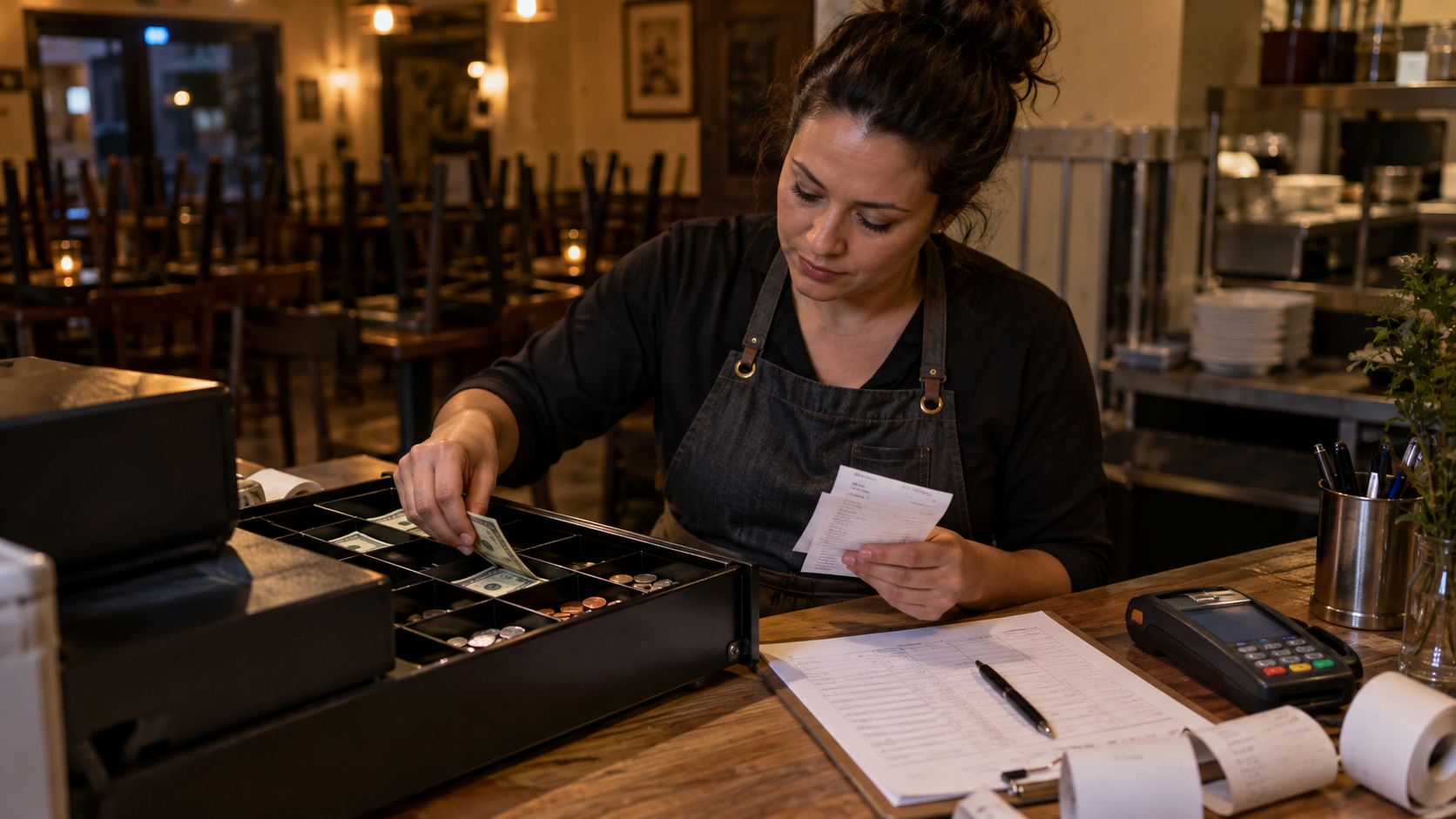
A cash drawer can be off for ordinary reasons: a change mistake during a rush, a receipt entered twice, a refund handled in the wrong place, or a starting float that was never written down. The trouble begins when nobody can tell which reason applies.
Restaurant cash reconciliation is the short, repeatable process of comparing what the records say should be in the drawer with what is actually there. Done daily, it catches small problems while the shift is fresh. Done occasionally, it becomes a search through memory.
Start with expected cash
Before you count the drawer, identify what should be there:
Starting float + cash sales + cash paid in - refunds - paid-outs - cash removed during shift = expected cash at close.
The labels vary by POS. What matters is that every movement has a place. An emergency cash purchase should be recorded as a paid-out. An owner cash removal should be recorded as a drop. Without that record, the final count looks like a mystery shortage.
Keep the starting float stable where possible. A drawer that begins at $150 one day, $200 the next, and "whatever was left" on Friday makes comparison harder than it needs to be.
Count the physical cash carefully
Count notes and coins by denomination. Record the total before making a deposit or resetting the float. In a cash-heavy operation, use a second count or independent verification as appropriate for your internal controls.
Separate the agreed float from the deposit. Keep voids, refunds, paid-outs, and cash tips distinct from sales cash. Note unusual events before people leave: a drawer change, terminal outage, or manual receipt. Reconciliation only works when the physical cash and recorded activity use the same boundaries.
Compare, then explain
Actual cash - expected cash = over or short. A positive result is an over; a negative one is a short. Do not rush to "fix" it by changing a report number. Recount first and look for a clear explanation.
A useful closeout note might read: "Drawer short by $12.50; manual delivery payment entered after terminal reconnect; verify next morning." That is very different from "cash weird." For repeated or material differences, follow the escalation process and employment policies that apply to your restaurant.
Include other payment methods
Cash is only one part of a daily close. Most restaurants also compare card-terminal batches, delivery-platform reports, gift cards, discounts, refunds, and tips. You may not settle every provider the same night, but the sales records and payment records should point in the same direction.
| Area | Compare |
|---|---|
| Cash | Expected cash, actual count, float, deposit, over/short |
| Cards | POS card sales, terminal batch, refunds, tips |
| Delivery platforms | Reported sales, fees, expected payout timing |
| Discounts and comps | Authorization and reason |
| Paid-outs | Receipt, purpose, approver, amount |
A restaurant daily sales report is a good place to pull shift totals together. It supports reconciliation; it does not replace the physical count.
Look for patterns, not culprits
Repeated small differences usually reveal an unclear process: refunds entered inconsistently, an unrecorded float change, delivery cash with no handoff, or paid-outs noted too late. Ask whether the difference happens on one shift, one till, or one day. The point is not an interrogation. It is a process clear enough for honest people to follow and unusual results to stand out.
Use the restaurant manager logbook to leave a concise follow-up note for the next manager. If you do not use a POS, the same discipline applies--see how to track restaurant sales without a POS.
A closeout example
At the end of a Friday shift, the POS shows $1,240 in cash sales. The drawer started with a $150 float. A $60 cash paid-out for emergency supplies is supported by a receipt, and $900 was removed as an earlier documented drop. There were $30 in cash refunds.
Expected cash is $400: $150 float plus $1,240 sales, minus $60 paid-out, $900 drop, and $30 refunds. The manager counts $392. The first step is not to accuse anyone. Recount the denominations, confirm that the drop was included, and check the refund and paid-out entries. If the difference remains, record the $8 short with the shift details and follow the restaurant's procedure.
A small, documented difference may be resolved the next morning when a manual receipt or drawer transfer is found. A recurring pattern deserves a clearer process review. The value of the daily closeout is that it keeps both conversations close to the event.
Build controls that fit the restaurant
A single-drawer café and a multi-till restaurant do not need the same system. Small teams may have one manager count and another person verify when possible. Larger teams may assign individual tills, use sealed cash drops, restrict refund permissions, and require a manager approval for paid-outs. Choose controls that match the cash volume and the real risks instead of copying a complicated procedure nobody can sustain.
The basics are broadly useful: a fixed float, a count by denomination, receipts kept with paid-outs, clearly recorded refunds, and a named person who owns the final close. If staff rotate between drawers, record the handoff. If a till is shared, make the reconciliation timing clear.
Separate operational facts from payroll decisions
Cash discrepancies can affect sensitive employment matters. The closeout should record what happened: expected amount, actual amount, difference, known explanation, and follow-up. Decisions about deductions, discipline, privacy, and records need to follow the laws and policies that apply to your business. Do not turn a quick end-of-day sheet into legal or HR advice.
This separation makes the financial record more trustworthy. A manager can write an accurate note without deciding the outcome during a tired closing shift.
Common sources of avoidable errors
Look for these before assuming a shortage is mysterious:
- The starting float was not counted or changed without a record.
- Cash refunds were processed in the POS but not removed from the drawer, or vice versa.
- A paid-out receipt exists but the amount was not entered.
- A cash delivery payment was handled outside the normal drawer process.
- A cash drop was made but the bag or log was not matched at close.
- Tips, gift cards, vouchers, and card payments were mixed into the wrong line of the report.
Each is a process issue that can usually be made easier to follow. A better form, fixed location for receipts, or simple handoff rule may do more than a stern reminder.
Use the weekly review for trends
Daily reconciliation resolves immediate questions. A weekly review tells you whether the operation is improving. Compare over/short amounts by day, shift, and drawer. Look for recurring timing, such as a difference after a busy event, during a particular handover, or when a terminal is offline. Review voids and refunds with the same calm focus.
The goal is not to chase tiny variation forever. It is to see when small variation has become a repeated operational signal.
Where TableAI fits
TableAI can preserve daily sales totals and operational notes through WhatsApp, then bring them into a morning briefing. It does not count cash, connect to a payment terminal, or reconcile card batches. Keep the cash closeout as a separate controlled process.
Common questions
What is an acceptable over or short? Set a threshold that suits your volume and policy, then investigate repeated or material differences.
Should the same person count and verify? Your controls depend on your setup. Many restaurants use one person to count and another to verify when cash volume is meaningful.
Can we reconcile weekly? You can, but daily closeout is usually easier because receipts and events are still fresh.