The honest answer to "how much does it cost to open a restaurant" is a range wide enough to be almost useless on its own: anywhere from around $75,000 for a small food truck to well over half a million for a full-service restaurant built from a raw space. What matters isn't the industry average. It's your number, built line by line from the format you're actually opening. And the gap between those two extremes comes down mostly to one decision — how much of the kitchen you build versus inherit.
This is a breakdown, not a pep talk. What follows is where the money actually goes, how it shifts by format, the costs first-time owners routinely forget, and the one line that has nothing to do with the build: the cash you keep in reserve for the months before you turn a profit.
The startup cost ranges by format
Format decides more than any other factor, because it decides how much space, seating, and kitchen you are paying to create. These are commonly cited 2026 ranges, meant for planning, not promises.
- Food truck: ~$75,000-$150,000 (the truck and build-out are the big items; no rent)
- Takeaway / delivery-only (cloud kitchen): ~$75,000-$200,000 (small footprint, no dining room)
- Cafe / coffee shop: ~$100,000-$300,000 (equipment-heavy, but often smaller space)
- Quick-service / fast-casual: ~$150,000-$400,000 (counter service, leaner labor design)
- Full-service restaurant: ~$250,000-$500,000+ (dining room, full kitchen, higher everything)
- Fine dining: $500,000+ (premium build-out, equipment, and location)
The lower-cost formats are lower for a reason worth understanding. They cut the two most expensive things: seating and kitchen build-out. A cloud kitchen skips the dining room entirely. A food truck skips rent and shrinks the kitchen to what fits in a vehicle. If capital is your constraint, format is the lever you pull, not corner-cutting on a full build.
Where the money actually goes
Whatever the format, startup costs fall into the same buckets. Below is a representative breakdown for a full-service restaurant, the most expensive common case, so you can see the shape and scale it down for a leaner concept.
Leasehold and build-out — often the largest line
Leasehold improvements ...... $50,000-$200,000
Kitchen equipment ........... $40,000-$120,000
Furniture & dining fixtures . $20,000-$60,000
Signage & exterior .......... $5,000-$20,000
Turning a raw or mismatched space into a working restaurant is where the biggest checks get written. That's exactly why taking over a former restaurant with an intact kitchen and dining room is the single most powerful way to cut startup costs. You inherit hood systems, grease traps, and gas lines that cost a fortune to install from scratch.
Opening and pre-launch costs
Permits, licenses, health .. $5,000-$20,000
Initial inventory .......... $5,000-$25,000
Smallwares & supplies ...... $5,000-$20,000
POS & technology setup ..... $2,000-$15,000
Initial marketing .......... $5,000-$20,000
Professional/legal fees .... $3,000-$15,000
Individually these look small next to the build-out. Together they add up to a category that is very easy to under-budget, because none of it is the exciting part of opening a restaurant.
The line that saves restaurants: working capital
Working capital reserve .... 3-6 months of operating expenses
This is the most important number on the page, and the one most often left off the spreadsheet. Most restaurants don't turn a profit in their first months. Rent, payroll, and food costs run in full while revenue is still building and word is still spreading. Running out of cash before the business finds its feet is one of the most common ways new restaurants close, and it has nothing to do with the food being good. Hold three to six months of full operating costs in reserve, separate from your build-out budget, and treat it as untouchable.
The costs first-time owners forget
The spreadsheet that sinks a new restaurant is not usually wrong about rent or equipment. It forgets the quiet lines:
- Working capital, covered above, and the biggest single omission.
- Permits and licensing, which vary by city and take longer and cost more than expected. Liquor licenses in particular can be a large, slow line.
- Contingency. Build-outs run over — reliably. Put a 10 to 15 percent contingency on construction and treat it as a real line, not a hope.
- Initial marketing. A restaurant nobody knows about is empty. Budget for the launch, not just the build.
- Professional fees. Lawyers, accountants, and permit expeditors cost money up front and save more than they cost.
- Smallwares. Plates, glasses, pots, and utensils are individually cheap and collectively thousands.
- Deposits. First and last month's rent, utility deposits, and equipment deposits all land before you open.
Miss any one of these and a tight but workable budget becomes a cash crisis by month two. The fix isn't optimism. It's a line item.
How to bring startup costs down without cutting corners
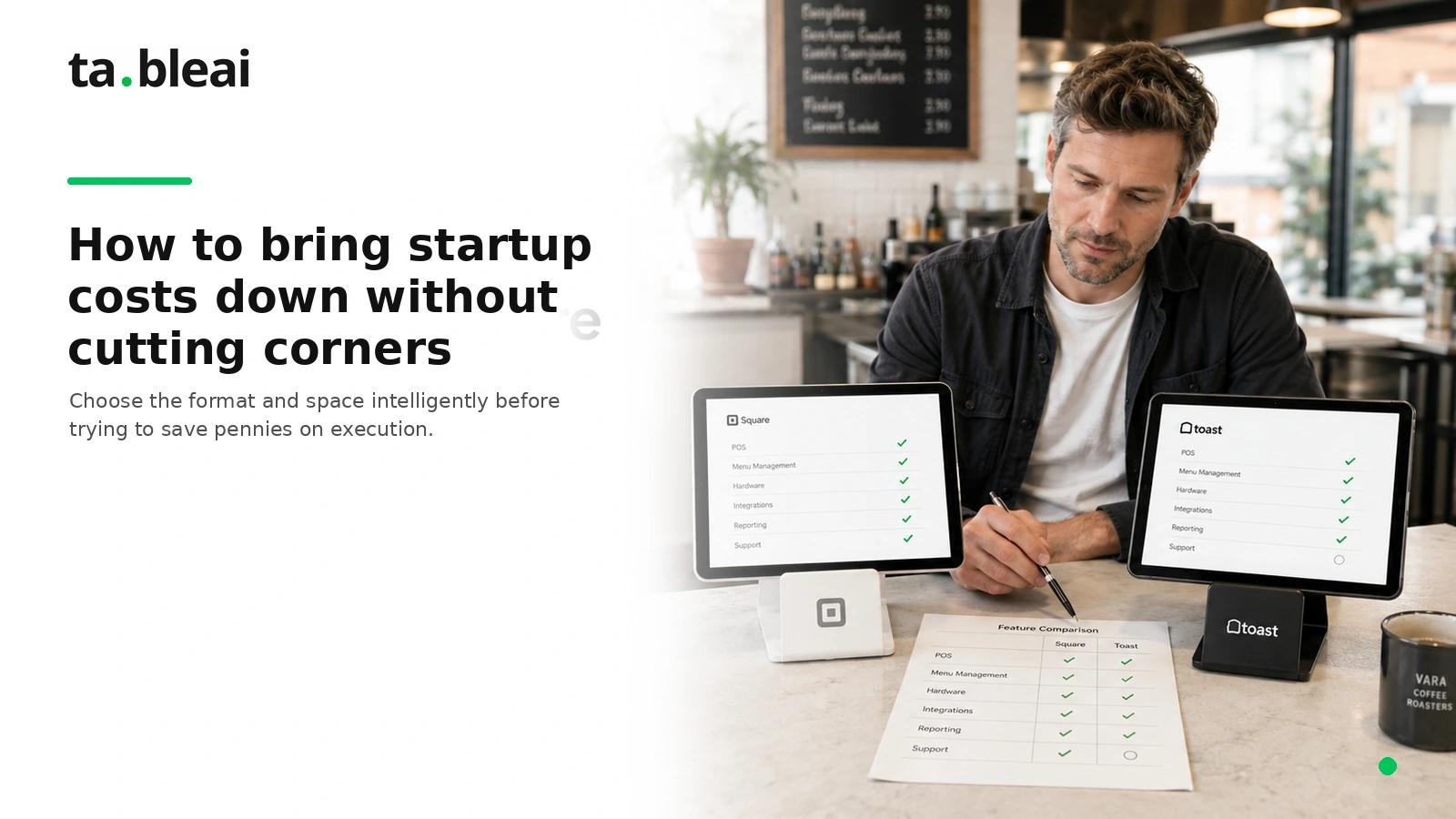
There's a difference between cutting costs and cutting quality. The smart reductions change what you build, not how well.
1. Take over an existing restaurant space. Inheriting a working kitchen and dining room is the biggest legitimate saving available, often six figures.
2. Choose a leaner format. A counter-service, takeaway, or truck concept opens for a fraction of a full-service build. If the concept fits, the quick-service model is far cheaper to launch and to staff.
3. Buy used equipment selectively. A used walk-in or prep table is money saved with no real downside. The line and refrigeration you lean on every day are where buying new can be worth it.
4. Phase the build. Open with the core menu and space, expand once revenue is real. Every dollar not spent before opening is a dollar in your working-capital reserve.
5. Keep technology simple. You don't need every system on day one. A lean setup, sometimes not even a full POS, keeps both the startup line and the monthly cost down. See how much restaurant software actually costs and how to avoid overbuying.
Before you open: know your break-even
Startup costs get you through the door. Whether you stay open depends on a different number: your break-even, the revenue you need each month just to cover costs. Work it out before you sign a lease and you find out whether the rent and the seating can actually support the business, or whether the format is doomed on paper before you spend a cent.
Run the break-even math on your planned rent, labor, and average check, and you will know how many covers a day this place needs to survive. If that number is unrealistic for the space and location, better to learn it now than after the build-out. And once you open, the average restaurant profit margin is thin enough that watching your costs from day one is not optional.
That daily watching is where a lot of new owners struggle, because the first months are chaos and the numbers get lost. TableAI keeps the two inputs that matter — sales and labor — flowing over WhatsApp from your first day open. You text in daily sales, log attendance, and get a 7am briefing with yesterday's numbers, so you can see whether you're tracking toward break-even while there's still time to react. It isn't a POS and it won't build your restaurant, but it keeps the early months from being a blind sprint. See how it works in running a restaurant from your phone, or check TableAI's pricing.
Frequently asked questions
How much does it cost to open a restaurant?
It varies enormously by format and location, but commonly cited ranges run from roughly $75,000 for a small food truck or takeaway counter to $250,000 to $500,000 or more for a full-service restaurant with a build-out. The single biggest swing factor is whether you lease an existing kitchen space or build one from scratch.
What is the biggest startup cost for a restaurant?
Usually the kitchen build-out and equipment, or the leasehold improvements to turn a raw space into a working restaurant. Together these can run six figures for a full-service spot. Taking over a former restaurant with an intact kitchen is the biggest single way to cut startup costs.
How much working capital do I need to open a restaurant?
Plan to hold roughly three to six months of operating expenses in reserve on top of your build-out and opening costs. Most restaurants do not turn a profit in the first months, and running out of cash before the business finds its feet is one of the most common reasons new restaurants close.
Can you open a restaurant with little money?
Lower-cost formats make it possible. A food truck, a takeaway or delivery-only kitchen, or taking over a fully equipped former restaurant can bring startup costs down substantially compared with a full build-out. You trade a smaller footprint and less seating for a far lower entry cost.
What startup costs do new restaurant owners forget?
The common blind spots are working capital for the unprofitable early months, permits and licenses, initial marketing, professional fees, a smallwares and supplies budget, and a contingency buffer for the build-out running over. Under-budgeting these is what turns a tight opening into a cash crisis.
Bottom line
Restaurant startup costs run anywhere from around $75,000 to well over $500,000, and the format you choose decides where in that range you land — it sets how much seating and kitchen you pay to create. Build the number line by line for your actual concept rather than trusting an average, and treat the leasehold build-out as the place to save through format and inheritance, not corner-cutting.
The line that saves restaurants is the one most often forgotten: three to six months of working capital for the unprofitable early months. Budget the build, budget the hidden costs, and then budget the runway to survive until the business finds its feet. Restaurants rarely fail because the food was bad. They fail because the cash ran out first.
Related reading: