If you've been trying to figure out what restaurant software actually costs, you've probably noticed something strange: every provider's website shows a low starting price ($0, $29, $69, $99) and none of them show what a real restaurant actually pays each month. That gap between the advertised number and the actual invoice is where most owners get burned.
This guide fixes that. Below is a real breakdown of what small restaurants pay for software in 2026 — including all the fees that don't show up in the marketing copy. Numbers come from published pricing pages, independent reviews, and reports from actual restaurant owners.
The short version
If you don't want to read the whole thing:
- A small cafe with basic needs: Realistic monthly spend of $50-$300 for software alone, plus 2.5-3% in card processing fees on top.
- A busy full-service restaurant: Realistic monthly spend of $500-$2,500 all-in, with processing fees being the biggest single line item.
- A restaurant that doesn't take cards at all (pure cash): Can operate with $0/month in software using free tools like Homebase and a paper log.
- The pricing you see advertised is almost never the price you'll pay. The published starter prices exclude processing fees, hardware, and add-on modules. Add all four together to get your real cost.
The cheapest doesn't always win. The most expensive doesn't always give you the most. Below is what actually maps to what.
The four costs that make up your total bill
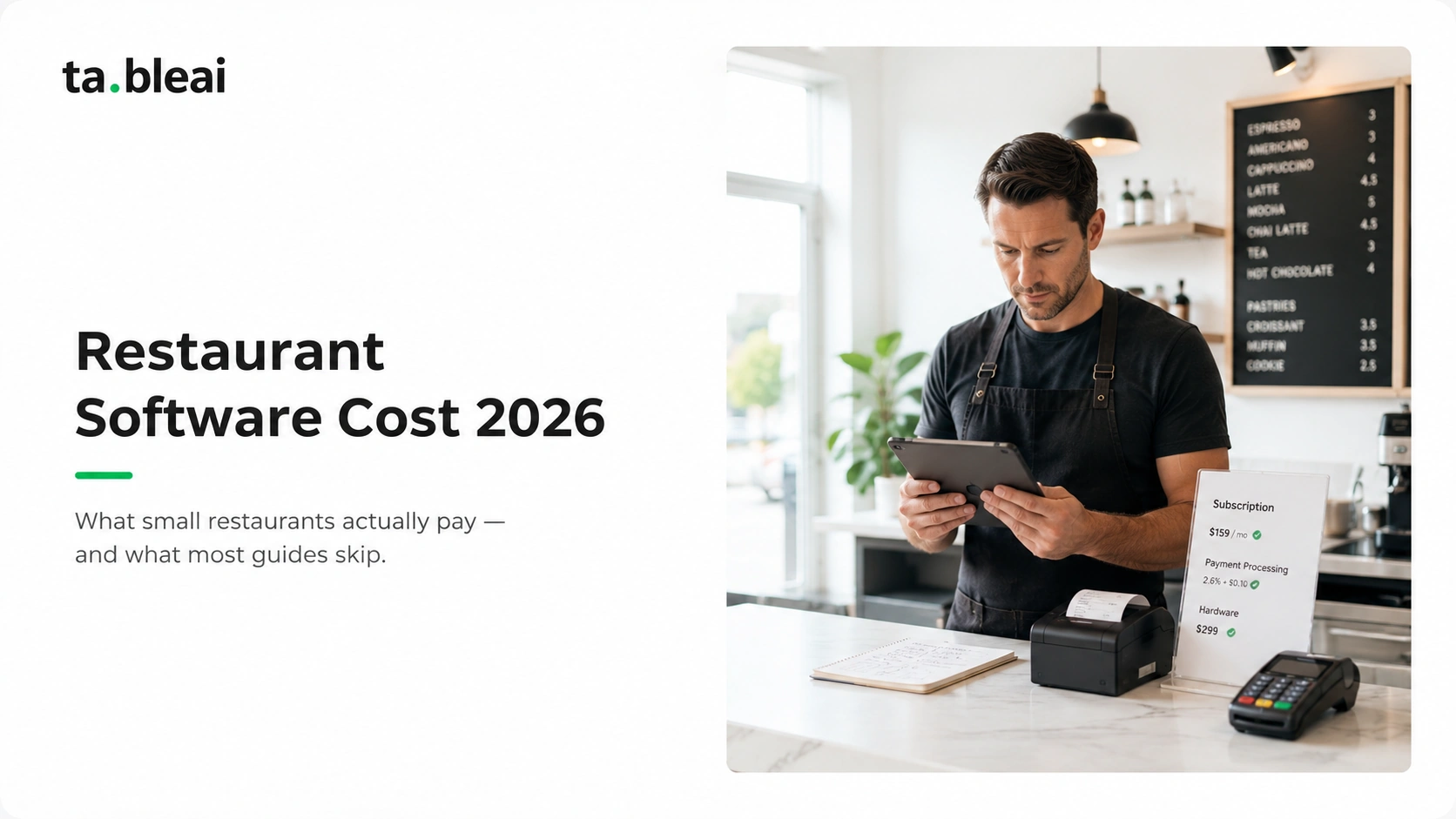
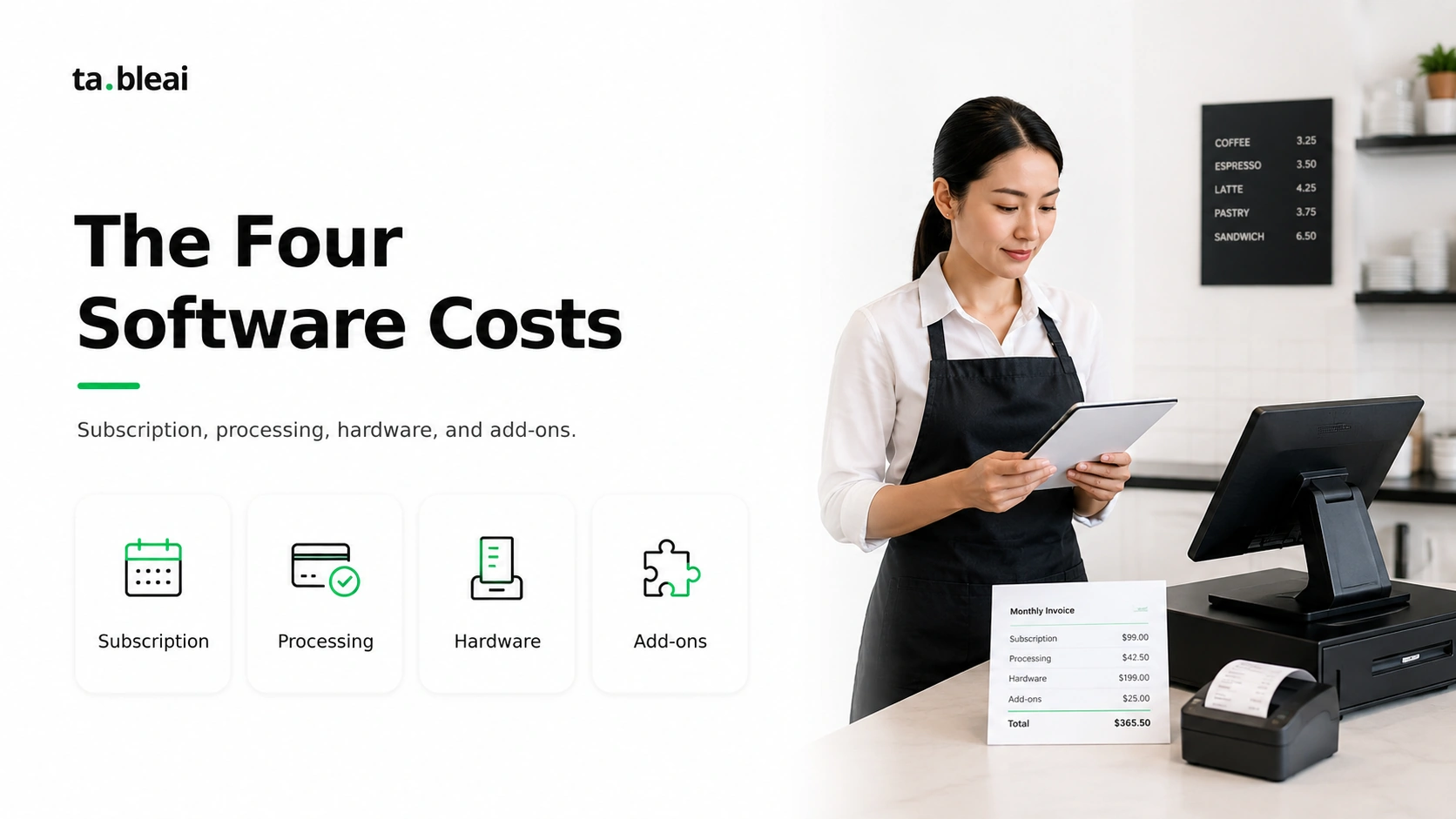
Every restaurant software provider — whether it's Toast, Square, Clover, Lightspeed, or a lightweight alternative — will bill you for some combination of these four things. Understanding the four is the difference between predicting your invoice accurately and getting shocked by it.
Cost 1: Software subscription
The monthly fee for using the software. This is what shows on the marketing page.
2026 published starting prices:
- Toast: $0/month (Starter) or $69/month (Point of Sale)
- Square for Restaurants: $60/month
- SpotOn Restaurant: $99/month
- Clover: $60-165/month depending on plan and reseller
- Lightspeed Restaurant: $69/month (Essentials) up to $399/month (Pro)
- 7shifts (scheduling only): $0/month (free tier) or $34.99/month
- Homebase: $0/month (free tier) or $24.95/month
- TableAI: $0/month during early access, planned $29-49/month
These are the "sticker prices." They cover the core software. They do not cover any of the next three costs.
Cost 2: Payment processing fees
The percentage of every card transaction that goes to the payment processor. For most restaurants, this is the biggest single line item on the invoice — larger than the software fee, often by 5-10x.
2026 typical processing rates:
- Toast: 2.49% + $0.15 per transaction (standard) or 2.99% + $0.15 (Starter plan), and you cannot bring your own processor
- Square: 2.6% + $0.10 (standard rate, published, transparent)
- Clover: 2.3-3.5% depending on the reseller who sold you the account
- SpotOn: Negotiable (sometimes as low as 1.99% + $0.15 for higher-volume restaurants)
- Lightspeed: 2.6% + $0.10 (Lightspeed Payments) or bring-your-own processor
- Independent processors (Stripe Terminal, etc.): 2.5-2.7% + $0.10, fully negotiable at volume
The math: A restaurant with $50,000/month in card sales at 2.6% pays $1,300/month in processing alone. At 2.99%, they pay $1,495. That difference of $195/month is $2,340/year — often more than the annual software subscription cost.
Cost 3: Hardware
The physical equipment: terminals, card readers, receipt printers, kitchen display screens, cash drawers.
2026 hardware costs:
- Basic card reader (mobile use): $49-$99
- Handheld tablet POS: $299-$799
- Countertop terminal: $799-$1,499
- Kitchen display system: $500-$1,500 per screen
- Receipt printer: $200-$500
- Cash drawer: $150-$300
How it's paid: Some providers require upfront payment (Toast's standard plan requires hardware purchase). Some offer financing over 12-36 months. Some (like Toast's Starter Kit) bury the hardware cost into higher processing fees, so you pay "nothing" upfront but pay more per transaction forever.
Small operators frequently underestimate this. A "free" software plan with $2,000 in hardware costs is not free. Divided over 24 months, it's another $83/month effectively.
Cost 4: Add-on modules
Extra features not included in the base plan. These are how providers get their bill from "reasonable" to "shocking."
Common add-on modules and typical monthly costs:
- Online ordering: $50-150/month
- Loyalty program: $25-75/month
- Marketing / email tools: $25-100/month
- Advanced inventory: $50-100/month
- Team management / scheduling: $30-100/month
- Payroll: $40-100/month base + $6-12 per employee
- Delivery integration: $30-100/month
- Reporting / analytics: $25-75/month
- Multi-location management: $50-200/month per additional location
The trap: A cafe on the $69/month Toast Point of Sale plan might reasonably add online ordering ($75), loyalty ($40), and inventory ($60) — bringing the software cost alone to $244/month before touching processing fees. This is why the advertised "$69/month" rarely matches the actual bill.
What small restaurants actually pay (with real math)
Let's put the four costs together for realistic restaurant profiles.
Profile 1: Small cafe, 12 seats, mostly counter service
- Card volume: $20,000/month (60% of $35K total revenue is card sales)
- Needs: Basic POS, no online ordering yet, no loyalty program
- Software: Square for Restaurants base plan
- Hardware: One Square Terminal ($299 upfront, or ~$25/month over 12 months)
Monthly breakdown:
- Software: $60
- Processing: $20,000 × 2.6% + (avg 1,000 transactions × $0.10) = $620
- Hardware amortized: $25
- Add-ons: $0
- Total: $705/month
Same cafe on Toast Starter Kit:
- Software: $0
- Processing: $20,000 × 2.99% + (1,000 × $0.15) = $748
- Hardware: $0 upfront (built into processing)
- Add-ons: $0
- Total: $748/month
Same cafe on Toast Point of Sale plan:
- Software: $69
- Processing: $20,000 × 2.49% + (1,000 × $0.15) = $648
- Hardware: $30 amortized (if financed)
- Add-ons: $0
- Total: $747/month
Same cafe using cash + Homebase (no card processing through a POS, using a basic $49 mobile card reader for occasional cards):
- Software: $0 (Homebase free tier for scheduling and time tracking)
- Processing: Only on ~10% of sales that are cards = $50/month
- Hardware: $4/month amortized
- Add-ons: $0
- Total: $54/month
The takeaway for small cafes: If you're low-volume and low-complexity, using free tools plus a basic card reader saves ~$700/month vs. going with any full POS. That's $8,400/year that goes to your pocket instead of software fees.
Profile 2: Full-service restaurant, 30 seats, moderate volume
- Card volume: $80,000/month (85% of $95K total revenue)
- Needs: Full POS with kitchen display, tableside ordering, online ordering, basic loyalty
- Software: Toast Point of Sale with common add-ons
- Hardware: 2 handhelds ($1,600), 1 KDS ($1,200), 1 receipt printer ($400) = $3,200 upfront or ~$130/month over 24 months
Monthly breakdown:
- Software: $69 base + $75 online ordering + $40 loyalty + $60 inventory = $244
- Processing: $80,000 × 2.49% + (~3,500 transactions × $0.15) = $2,517
- Hardware amortized: $130
- Total: $2,891/month
Same restaurant on SpotOn Restaurant:
- Software: $99 base + $50 online ordering + $30 loyalty = $179
- Processing: Negotiated to 2.19% = $80,000 × 2.19% + $525 = $2,277
- Hardware: Included in plan lease
- Total: $2,456/month
Savings by switching: $435/month, or $5,220/year, without losing meaningful features.
Same restaurant using Square for Restaurants Plus:
- Software: $60 base + $50 online ordering + $25 marketing = $135
- Processing: $80,000 × 2.6% + $350 = $2,430
- Hardware amortized: $110
- Total: $2,675/month
Similar to Toast but transparent, negotiable, and no forced processor lock-in.
Profile 3: Very small operation, mostly cash
- Total revenue: $15,000/month
- Card volume: $2,000/month (only occasional card takers)
- Needs: Track sales, staff attendance, basic inventory. No POS needed.
- Software: TableAI (WhatsApp-based) + Homebase free tier for scheduling
- Hardware: One $59 card reader for occasional cards
Monthly breakdown:
- Software: $0 (TableAI early access) + $0 (Homebase free tier) = $0
- Processing: $2,000 × 2.6% = $52
- Hardware: $2/month amortized
- Total: $54/month
Even after TableAI's early access ends and it moves to $29-49/month:
- Total: $83-103/month
The takeaway: For genuinely small operations, the total software cost can be under $100/month. Many restaurants of this size are paying $500-1,000/month for a full POS ecosystem they don't need.
Costs almost every guide skips
The four cost categories above are the visible ones. There are three more that quietly add up.
Chargebacks. When a customer disputes a card charge, you pay $10-25 per dispute regardless of who wins. Small restaurants typically have 1-3/month.
Statement fees, PCI compliance fees, monthly minimums. Buried in the fine print. Often $10-30/month total across all these small line items.
Rate increases. Most processors reserve the right to raise your processing rate with 30 days' notice. A 0.2% bump on $50K/month in card volume is $100/month you didn't budget for. Ask specifically about rate guarantee terms before signing.
How to actually budget for restaurant software
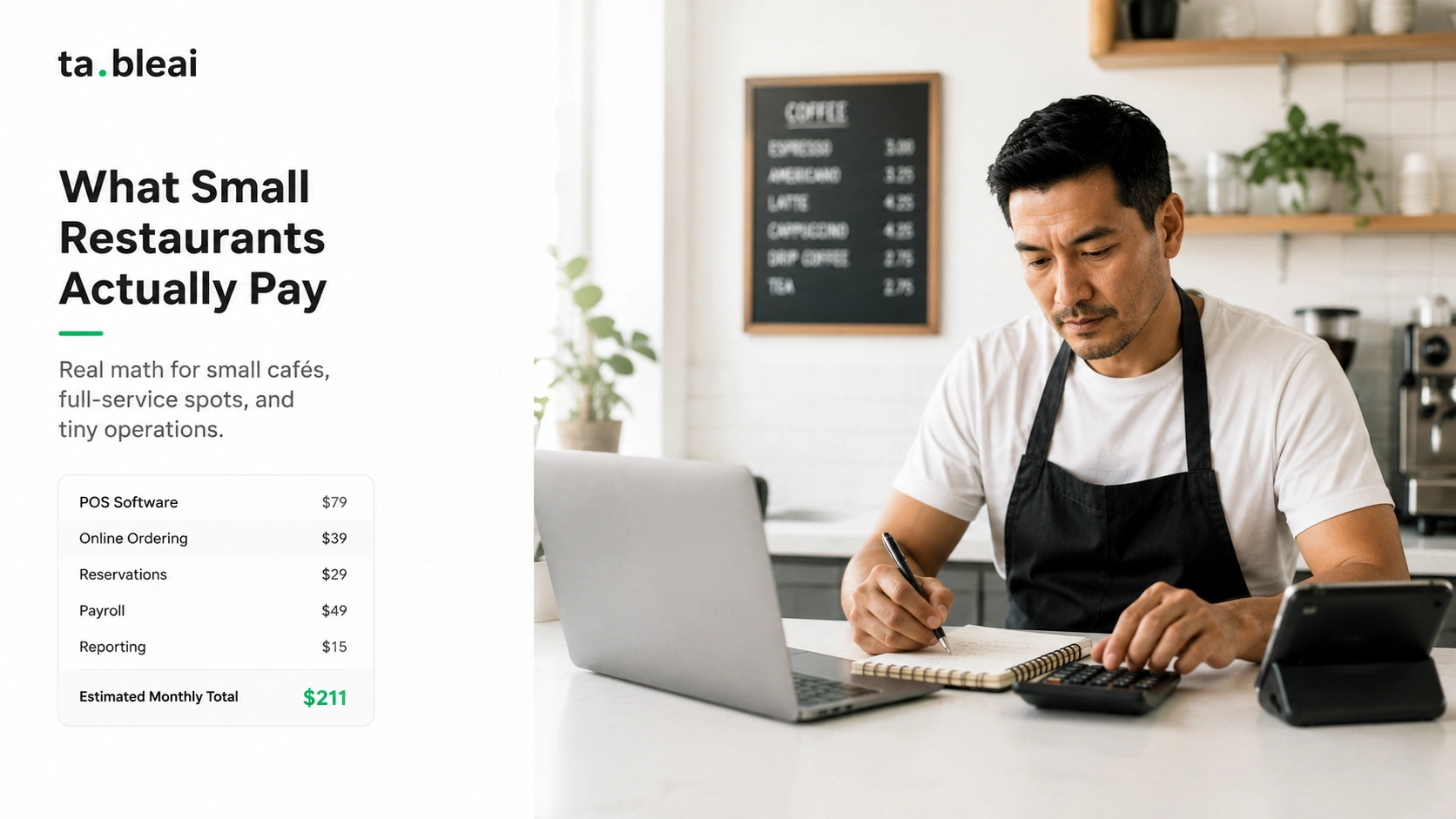
Rather than starting from "which software?", start from "what can I afford?"
Step 1: Look at last month's revenue. Note total revenue and card revenue separately.
Step 2: Budget 3-5% of total revenue for the entire software ecosystem. For a restaurant doing $50K/month, that's $1,500-$2,500 total for software + processing + hardware.
Step 3: Work backwards. Card processing at 2.5-3% will eat most of that budget already. If you're doing $50K/month with 80% card sales, that's ~$40K in card volume × 2.75% = $1,100 in processing. That leaves $400-1,400 for software, hardware, and add-ons.
Step 4: Prioritize what actually matters. In order: reliable payment processing → basic sales tracking → inventory alerts → scheduling → advanced features. If your budget only covers the first two, don't buy the rest yet.
Cheaper doesn't always mean worse
The single most common mistake in restaurant software is assuming higher price equals better fit. It doesn't. The right software matches your operation's actual complexity.
If you're a 12-seat cafe, the "best" software for you is probably a $60/month tool plus a $49 card reader. A $2,000/month Toast setup would technically work but you'd be paying for 80% capabilities you never use.
If you're a 60-seat full-service restaurant with a busy Friday night, the "best" software for you probably is Toast or SpotOn, and the $1,500-$2,500/month cost is legitimately worth it because the alternative would slow your operation down.
The mismatch happens when small restaurants buy enterprise-grade software (because the sales rep pitched it well) or when large restaurants try to run on lightweight tools (and constantly hit friction).
Common questions
What's the average monthly cost of restaurant software?
For US restaurants, roughly:
- Coffee shops and small cafes: $200-500/month all-in
- Fast casual: $500-1,000/month
- Full-service (30 seats): $1,000-2,500/month
- Multi-location or fine dining: $2,500-5,000+/month
Processing fees are the largest single component of these numbers for most restaurants.
Can I run a restaurant with completely free software?
Yes, if you accept the limits. You can use Homebase's free tier for scheduling, a paper log for sales, and a basic card reader for the small number of card sales. This works for very small operations (food trucks, tiny cafes, farmers market stalls). It stops working when you need faster service or better data.
Why is restaurant software so much more expensive than software in other industries?
Two reasons: payment processing is genuinely expensive (Visa/Mastercard charge merchants ~1.5-2.5% just to accept a card, and processors add their margin on top), and restaurant-specific software is a small market that supports fewer providers, so competition is less intense.
How much do add-ons really add to my bill?
For a typical full-service restaurant, add-ons commonly double or triple the base software cost. A $69/month base plan often becomes a $200-300/month all-in software cost once you add online ordering, loyalty, and payroll. Look at your actual invoice line by line.
Is it worth switching software to save money?
Do the math. If the savings are under $200/month, the migration hassle probably isn't worth it (2-4 weeks of setup, training, and data transfer). If savings are $500+/month, it's almost always worth it. In between, it depends on how much friction the switch will cause.
What about hidden fees?
Read the merchant services agreement carefully. Common hidden fees include:
- Monthly minimum processing fees ($15-50 if you fall below a threshold)
- PCI compliance non-compliance fees ($20-30/month if you don't complete annual PCI attestation)
- Batch fees ($0.10-0.30 per settlement batch)
- Early termination fees ($200-500+ if you cancel before your contract ends)
- Rate increase notices (often just 30 days)
Bottom line
Restaurant software costs are much more variable than they look. Two restaurants of the same size can pay wildly different amounts based on which provider they picked, which processing plan they're on, and how many add-ons they've bought.
For most small independents, the honest answer is that you should be paying 3-5% of total revenue on your entire software ecosystem — no more. If you're paying more than 5%, you're probably over-provisioned. If you're paying under 3%, you might be missing tools that would actually help you.
If you want to try the low-cost end of the spectrum, TableAI is free during early access — it covers sales tracking, inventory alerts, and staff attendance via WhatsApp. Not a POS, so you'd still need something at the register for card sales.
Whatever you pick, know exactly what you're paying every month across all four cost categories. The restaurants that stay profitable are the ones that treat software the same way they treat food cost: measured, controlled, and questioned regularly.