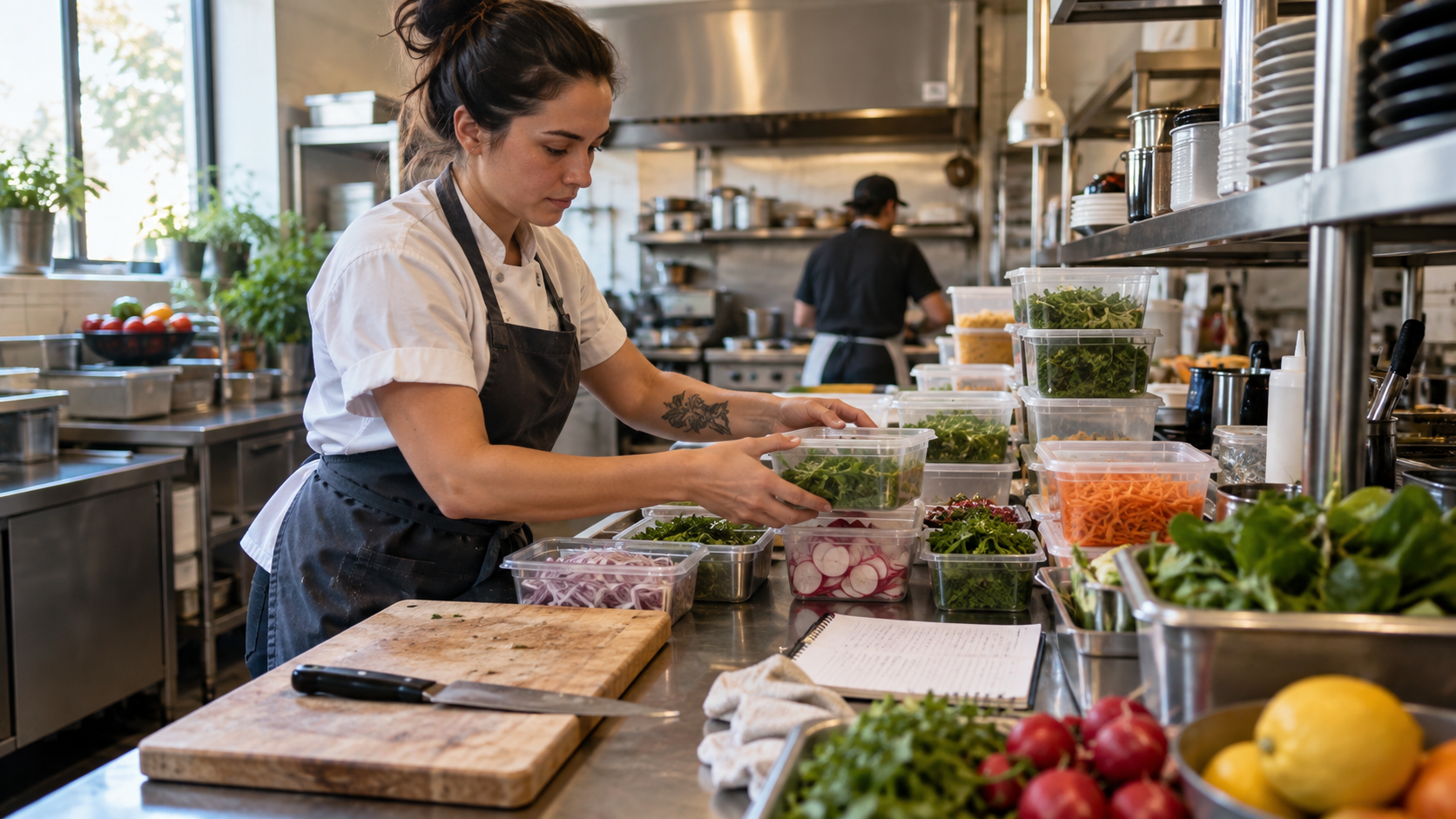
A prep list should make the first hour of a kitchen calmer, not turn it into a race to fill every container in sight.
The best restaurant prep lists answer a practical question: what do we need ready for today's service, given what we already have and what we are likely to sell? They are not a list of everything the restaurant could produce. They are a plan for the next shift.
Give every item a target and a unit
"Prep salad" is not a useful instruction. "Wash and cut 6 kg romaine; current usable stock 2 kg; target 8 kg" is. For each item, include the item, unit, usable stock on hand, target for service, amount to prep, owner, and a short note.
| Field | Example |
|---|---|
| Item | Lemon-herb dressing |
| Unit | Litres or batches |
| On hand | 1.5 litres |
| Target | 4 litres |
| Prep amount | 2.5 litres |
| Note | Check again at 4pm |
Use units people can measure consistently. Batches are fine if a batch is defined. "One pan" is fine if the pan size is stable. The problem is a unit that changes with every person.
Build the target from three inputs
Use recent comparable sales, current usable stock, and known changes. Look at recent Fridays when planning a Friday, not an average of every day in the month. Count product that is already opened, thawed, cooled, or prepared before asking someone to make more. Then account for bookings, local events, weather, promotions, and delivery demand.
A café that usually sells 35 chicken sandwiches and expects an office event may need more chicken--but only after subtracting what is already ready. The target is an informed estimate, not a promise. It is allowed to change when the day gives you better information.
Split work into now, later, and check again
One long list encourages teams to finish every item before service, even when demand is uncertain. Instead, separate:
- Prep now: items that need lead time, cooling, marinating, or are dependable sellers.
- Prep later: items that can be made quickly once demand is clearer.
- Check again: products reviewed at a specific time before making more.
This protects service without converting uncertain sales into waste. It is especially useful for perishable garnishes, sauces, fried components, and dinner-only sellers.
Connect prep to par levels--without confusing them
A par level describes the amount you want on hand. A prep list tells the team what to make today. A restaurant with a 12-litre sauce par and 9 litres usable should prep 3 litres, not automatically make a full new batch. That is why the list should always include what is already in the walk-in.
If the restaurant repeatedly makes more than it uses, review the item's shelf life, demand pattern, batch size, and par. Our restaurant par levels guide gives a practical starting method.
Keep the plan visible and review misses
Keep the list near the prep area. Cross off completed work, record unusual yields, and flag products for a later check. At the end of the week, look at items that were over-prepped, ran out, or slowed service. Change one thing: lower a first batch, add a 4pm check, clarify a unit, or move an item from prep-now to prep-later.
A manager logbook can carry the reasoning into the next shift. The prep list is the plan; the handover says what actually happened. Use a separate opening and closing checklist for routine readiness tasks so the prep sheet stays readable.
A prep-list example for a busy Friday
A neighbourhood restaurant expects a normal Friday dinner but has a 20-person reservation at 7pm. The morning count shows 18 portions of cooked chicken, 3 litres of sauce, and enough salad for 25 covers. Recent Fridays suggest 55 chicken dishes, but the booking makes the first hour less predictable.
The list can make the decision visible: prepare two chicken batches now, bring sauce to the service target, prep salad for the normal early rush, and check chicken and salad again at 4:30pm. The kitchen is not gambling on a single large forecast. It is using a first batch, a scheduled check, and enough time to react before the reservation arrives.
That is the heart of a useful prep list: not perfect prediction, but fewer surprises created by invisible assumptions.
Account for yield and usable stock
Do not write a prep target from sales alone. A batch may yield fewer usable portions than the recipe claims because trim, cooking loss, or an imperfect delivery changed the result. Record actual yields when they differ. Over a few weeks, the kitchen will see whether the standard batch is realistic.
Usable stock matters too. A container may be technically in the walk-in but unsuitable for the next service because it is already allocated, near the end of its approved holding time, or the wrong quality. Counting it as available makes the prep sheet falsely reassuring.
Coordinate front of house and kitchen
Prep gets better when information moves both ways. A manager who knows about a large booking, catering order, promotion, or local event should add it to the list before prep begins. During service, the kitchen should flag limited items early enough for the floor to set expectations with guests.
This does not mean every server needs the full sheet. It means the people making decisions know what is limited, what can be made again quickly, and what needs a manager's approval before the last batch is used.
Improve the sheet with actual outcomes
At the end of a week, compare planned quantities to what sold and what remained. Look for a few meaningful misses. If a product constantly runs out at 8pm, the list may need a later check or a different first-batch target. If a product regularly remains untouched, reduce the default target or move it into prep-later.
Do not edit the list after every abnormal shift. A rainstorm, group cancellation, or equipment failure may deserve a note rather than a new baseline. Patterns over comparable days are what make the next list more reliable.
Keep quality in the plan
A prep list is not only a volume tool. It should include important quality controls: cool a sauce before storing, label a batch, reserve a garnish, or hold a component until service. These reminders belong beside the item when they affect the next step. Routine cleaning, safety, and opening checks still belong in their own process.
Where TableAI fits
TableAI can preserve a concise stock or prep update through WhatsApp and surface it in a morning briefing. It does not forecast demand or calculate exact prep quantities. The kitchen still needs to use recent sales, current stock, and judgment.
Common questions
Who should make the prep list? Usually the chef, kitchen manager, or lead cook who understands current stock and expected demand.
How far ahead should it plan? Plan highly perishable items one service or one day at a time. Plan durable bases further ahead, but count what is usable first.
What if an item runs out every day? Check whether the target is too low, yield is smaller than assumed, or sales changed--then adjust the target, timing, or batch size.