Every small restaurant owner ends up at this comparison eventually. Toast and Square are the two most-searched restaurant POS systems in the US, and both companies actively market to independents. This post is the honest breakdown: real pricing, real feature differences, and a clear recommendation for who should pick which.
Quick answer
Skip the article if you want the short version:
- Pick Square if you're a small quick-service restaurant, cafe, food truck, or hybrid food-plus-retail business. You want a $0/month plan, no long-term contract, and predictable pricing you can understand without a sales call. This is most small restaurants.
- Pick Toast if you run a full-service restaurant with servers, kitchen stations, complex ticket flow, or plan to scale to multiple locations. You need depth in restaurant-specific features and you're OK with a two-year contract and higher real monthly cost.
- Skip both if you don't actually need a POS. A large percentage of small restaurants are paying $500-1,500/month for POS features they never use. If your operation is mostly cash, low complexity, and you just need sales tracking, look at lightweight alternatives.
Now the detailed breakdown.
The single most important difference
Before pricing, before features, before anything — understand this:
Toast is a restaurant-only company. Square is a general POS company that also does restaurants.
That's the core divergence, and everything else flows from it.
Toast built its entire product for restaurant workflows. Kitchen display systems, tableside handheld ordering, tip pooling, coursing (fire appetizers now, entrees in 10 minutes), split checks 5 ways with modifiers — all native. Their hardware is spill-resistant. Their support staff know restaurant terminology.
Square built its product for anyone taking payments — hair salons, retailers, food trucks, restaurants. Square for Restaurants is a specialized app that adds restaurant features to their general POS. It's very capable, but it's clearly a layer on top of a general-purpose system, not built from the ground up for restaurants.
What this means for your decision: if your restaurant is complex enough that you'd notice the difference between "restaurant-specific" and "general POS with restaurant features," you probably want Toast. If your operation is simple enough that you wouldn't notice, Square's lower cost and simpler pricing wins.
Real pricing comparison (verified August 2026)
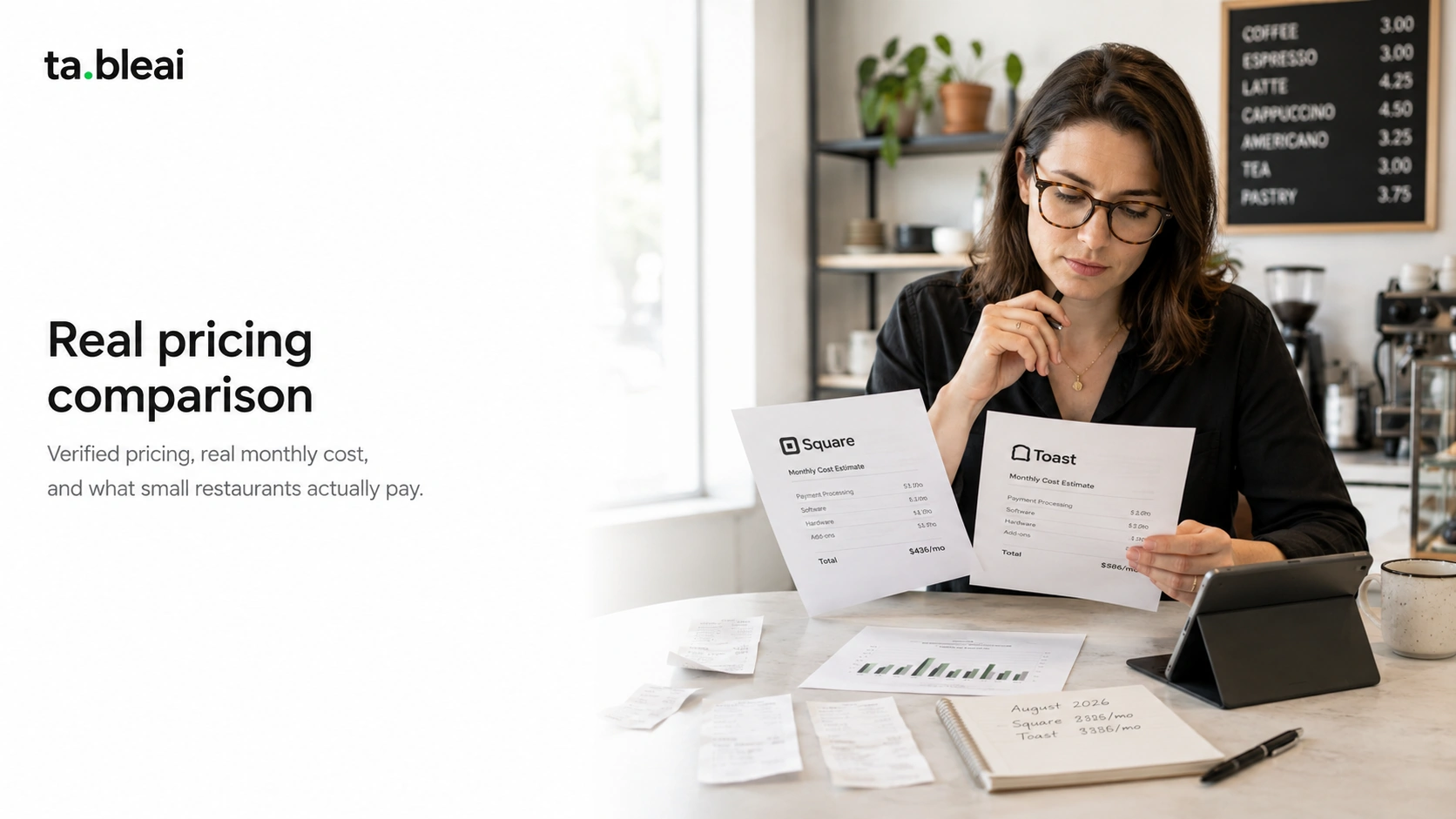
Both companies advertise low starting prices. Both real monthly costs are 3-5x higher. Here's what small restaurants actually pay.
Square for Restaurants pricing
- Free plan: $0/month. Includes basic POS, table management, Square Online ordering. Processing at 2.6% + $0.10 per in-person card transaction.
- Plus plan: $60/month per location. Adds advanced menu customization, KDS, floor plans, tableside ordering support.
- Premium plan: custom pricing. For multi-location operations doing $250K+/year, includes lower processing rates (down to 2.4% + $0.10).
Hardware: Square Terminal $299 upfront, Square Register $799, Square Stand for iPad $149. Contactless card reader $59. You can use your existing iPad for the free plan.
Contract: None. Cancel anytime.
Toast POS pricing
- Starter Kit: $0/month software. Processing at 2.99% + $0.15 (pay-as-you-go rate). Hardware financing built into higher processing fees.
- Point of Sale plan: $69/month per terminal. Processing at 2.49% + $0.15 (standard rate).
- Build Your Own bundle: starts at $110/month, scales with add-on modules.
Hardware: Toast Flex terminal $799+, Toast Go 2 handheld $609, Kitchen Display $999+, Kitchen printer $349. Required to run Toast — no BYOD (bring your own device) option.
Contract: Two-year contract standard. Early termination fees apply.
Payment processor: Locked. You cannot bring your own processor to Toast.
Real monthly cost for a typical small restaurant
Let's say you're doing $30K/month in revenue with 80% card sales ($24K in card volume, ~1,200 transactions).
Square (Plus plan):
- Software: $60/month
- Processing: $24,000 × 2.6% + 1,200 × $0.10 = $744
- Hardware amortized (Square Terminal over 12 months): $25
- Total: ~$829/month all-in
Toast (Point of Sale plan):
- Software: $69 base + $75 online ordering + $40 loyalty (common add-ons) = $184
- Processing: $24,000 × 2.49% + 1,200 × $0.15 = $778
- Hardware amortized (Flex + printer over 24 months): $50
- Total: ~$1,012/month all-in
Difference: ~$183/month, or $2,196/year. That's the real cost differential for a typical small restaurant.
At larger volume ($100K+/month card sales), Toast's lower processing rate closes the gap, and their advanced features may justify the premium. At smaller volume, Square wins on pure economics.
Feature-by-feature comparison
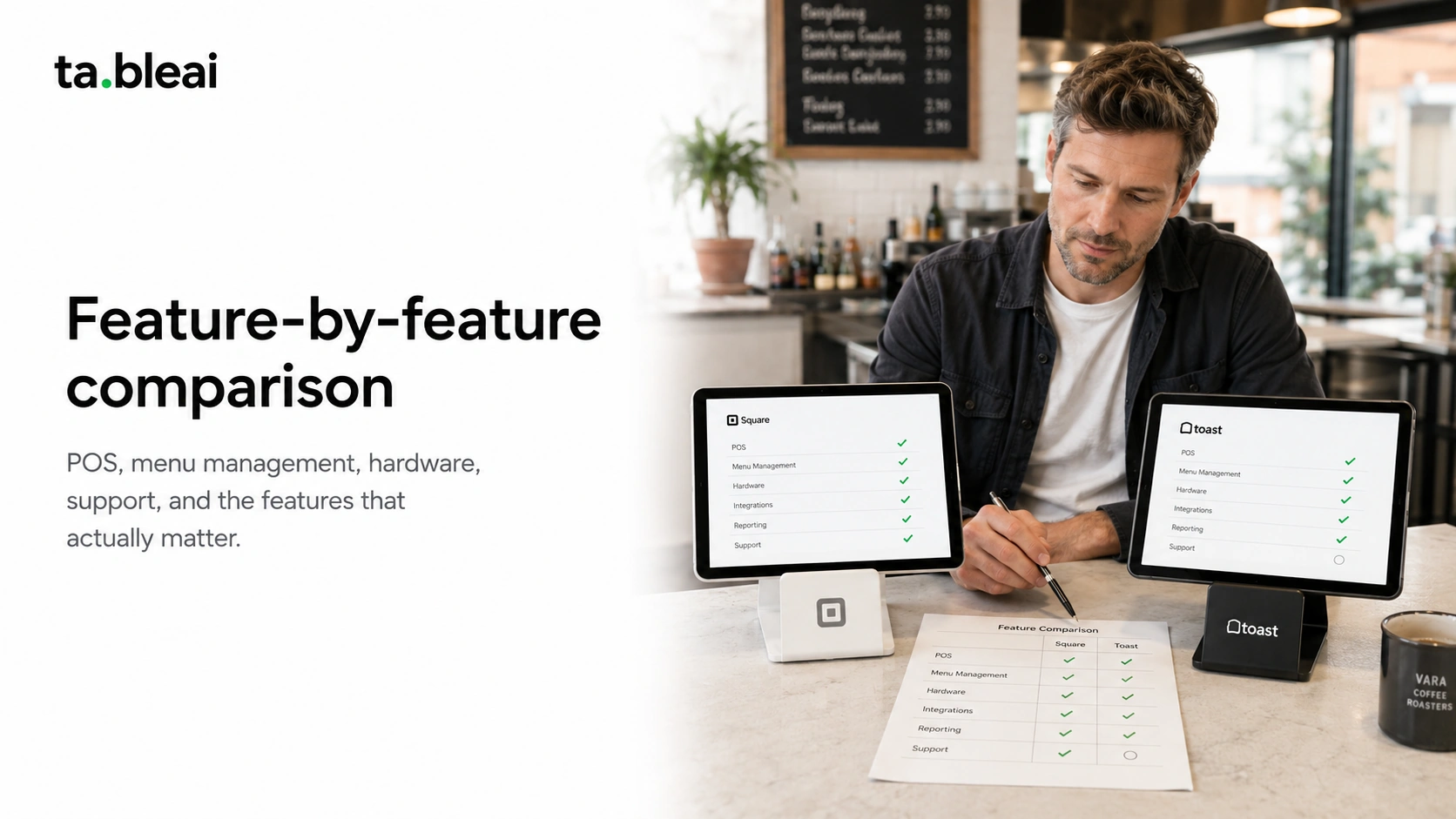
Here's how they compare on the things small restaurants actually use.
Point of sale (ordering, payments, receipts)
Square: Clean, intuitive interface. iPad-based on lower tiers, proprietary hardware on higher tiers. Fewer options for complex customization but covers 95% of quick-service and casual dining needs.
Toast: Purpose-built restaurant interface. Handles complex modifiers, coursing, split checks, seat management better than Square. Learning curve is steeper.
Winner for small restaurants: Square, unless your menu genuinely requires complex modifiers.
Menu management
Square: Menu editable from admin panel or mobile app. Menu changes push to all terminals in seconds. Supports modifiers, variations, discounts.
Toast: Deep menu management with recipe-level cost tracking on higher plans. Menu changes push instantly. Better for restaurants that update menus frequently or need ingredient-level tracking.
Winner: Toast if you have a complex, changing menu. Square if your menu is stable.
Kitchen display system
Square: Available on Plus and Premium plans. Requires Square hardware ($699 Kitchen Display).
Toast: Core feature, purpose-built for kitchen workflow. Multi-station routing, order timing, prep station customization all native.
Winner: Toast. This is where restaurant-specific design shows up most clearly.
Online ordering
Square: Square Online included in free plan. Basic branded ordering page, minimal transaction fees.
Toast: Toast Online Ordering as an add-on ($75/month). Deeper features (scheduled orders, third-party delivery integration, marketing tools).
Winner: Square wins on cost. Toast wins on depth. Depends on whether online ordering is core to your business.
Payment processing rates
Square: 2.6% + $0.10 (Free plan), 2.5% + $0.10 (Plus), 2.4% + $0.10 (Premium). Transparent, published, cannot be shopped around but also can't be raised arbitrarily.
Toast: 2.49% + $0.15 standard, 2.99% + $0.15 pay-as-you-go. Locked into Toast Payments. Rates can be increased with 30 days notice — this has happened to many operators after year one.
Winner: Square for predictability. Toast can be cheaper at very high volume but comes with lock-in.
Staff management and scheduling
Square: Square Team Management included on paid plans. Basic scheduling, time tracking, payroll (extra cost).
Toast: Toast Payroll and Team Management as add-ons ($40-100+/month). More restaurant-specific (tip pooling, split shifts, restaurant-specific labor cost tracking).
Winner: Toast if you need restaurant-specific labor tools. Square if basic scheduling is enough.
Reporting and analytics
Square: Clean dashboards, easy to understand. Real-time sales, top items, hourly trends. Sufficient for most operators.
Toast: Deeper analytics, more granular reports, better labor and food cost analysis. Overwhelming if you don't need it.
Winner: Toast for data-driven operators. Square for owners who just want to know "how'd we do today."
Customer support
Square: Support quality varies by plan. Phone support requires Plus or Premium. Response times can be slow on the free plan.
Toast: 24/7 phone support on all plans. Generally rated highly for restaurant-specific issue resolution.
Winner: Toast, clearly. If you value being able to call someone at 8pm on a Saturday when your POS goes down, Toast is better.
Hardware
Square: Consumer-grade tablets with Square accessories. Cheaper but less durable in kitchen environments.
Toast: Commercial-grade, spill-resistant, restaurant-durable. More expensive but designed for hot, wet, food-service conditions.
Winner: Toast for durability. Square for cost.
The 3 scenarios and clear picks
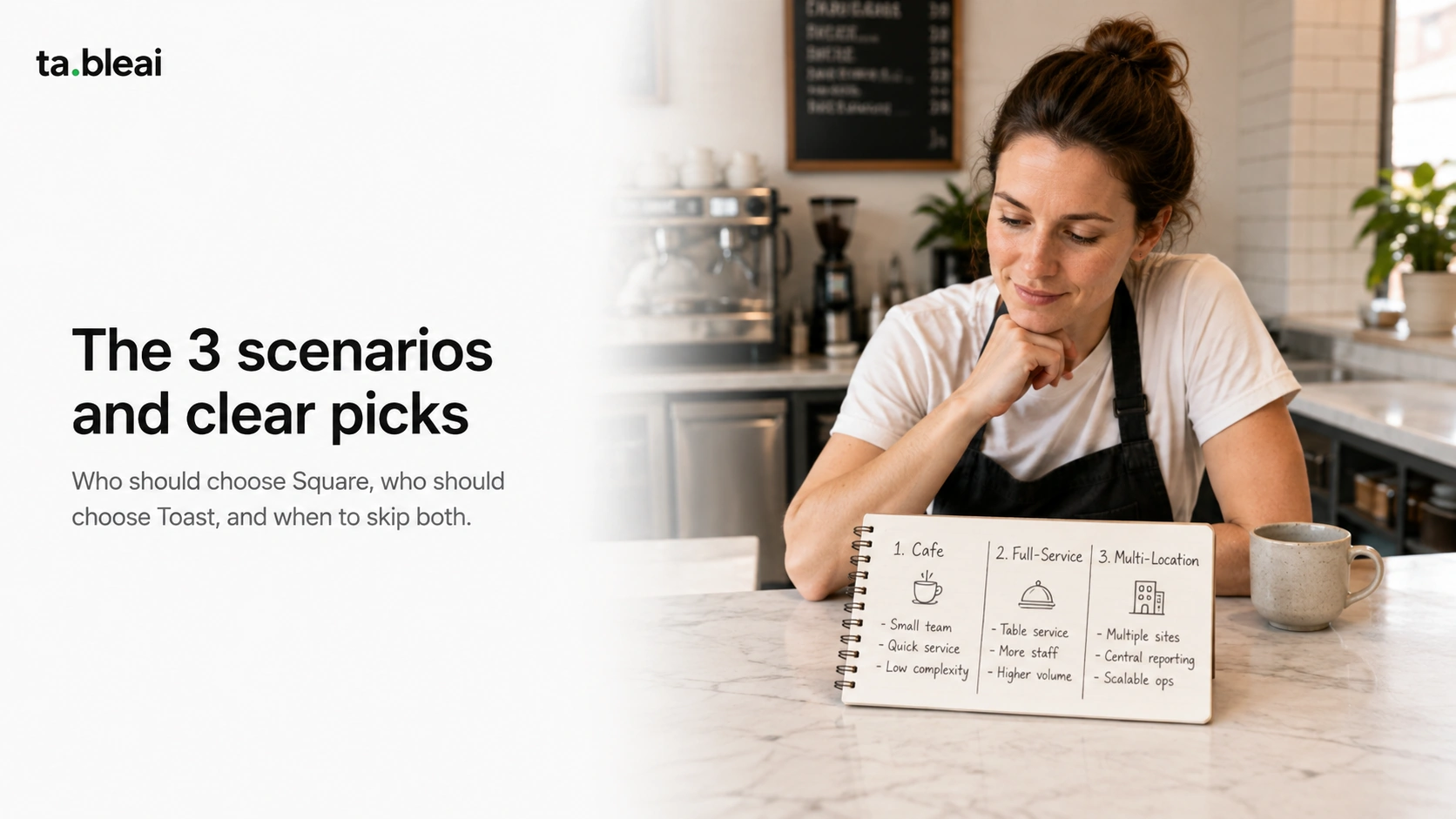
Instead of more feature charts, here are the 3 scenarios small restaurant owners actually face:
Scenario 1: Small cafe, food truck, or quick-service (under 25 seats)
Card volume: $10-40K/month. Complexity: Low. Simple menu, quick tickets, counter service. Needs: Reliable payments, basic sales tracking, easy staff onboarding.
Pick Square. The free plan or $60/month Plus plan covers everything you need. Toast is genuinely overkill and you'll pay 2x for features you never use.
Scenario 2: Full-service restaurant, 25-60 seats
Card volume: $40-100K/month. Complexity: Medium-high. Modifiers, splits, kitchen coordination, tableside service. Needs: Restaurant-specific workflow, kitchen display, tip management.
It depends. If you're rate-sensitive and simplicity matters, Square Plus can work. If you want the deeper restaurant tools and can absorb the higher total cost, Toast is the better fit long-term. This is where the decision gets genuinely close.
Scenario 3: Established restaurant or multi-location
Card volume: $100K+/month per location. Complexity: High. Multiple stations, complex menus, real inventory needs, multi-location reporting. Needs: Depth, integration ecosystem, 24/7 support.
Pick Toast. At this scale, Toast's restaurant-specific depth pays for itself. Square is capable but you'll hit the ceiling of what a general-purpose POS can do.
What both companies won't tell you
Two things that don't show up in either company's marketing:
1. You may not need a POS at all.
If you're doing $15-25K/month, mostly cash, with a simple menu, you might be over-buying at either Square Plus or Toast. Cash + a $59 Square card reader + a spreadsheet + a scheduling app like Homebase (free) covers everything for under $50/month all-in. Neither Square nor Toast will suggest this — they sell POS systems.
2. The migration cost matters more than the monthly bill.
Both companies make it easy to sign up and hard to leave. If you pick wrong and want to switch, you'll spend 2-4 weeks migrating menus, retraining staff, and rebuilding your reports. Small restaurants that switch POS systems every 12-24 months are usually losing more time than the software costs. Pick carefully once, live with it.
Common questions
Is Toast really that much more expensive?
For small restaurants, yes — $150-300/month more than Square for equivalent capability. The gap shrinks at higher volume. If you're doing $100K+/month, the effective cost per transaction is comparable.
Can I use my existing iPad with Toast?
No. Toast requires Toast hardware. Square supports iPads on all plans.
Which is easier for staff to learn?
Square, by most reports. Toast has more features and therefore more menus. New hires who've used Toast at other restaurants find it familiar; new hires who've never used any POS find Square more intuitive.
Do both integrate with online delivery (DoorDash, Uber Eats)?
Both integrate, but Toast's integration is more mature and includes tools for menu synchronization and consolidated reporting. Square's integration works but is more basic.
What about Clover, SpotOn, or Lightspeed?
Legitimate alternatives — see our full breakdown of Toast alternatives for details. Short version: Clover if you want to bring your own payment processor, SpotOn if you want Toast-like features with negotiable rates, Lightspeed if you have complex inventory needs.
Can I try both before committing?
Square's free plan lets you try their software with almost no risk. Toast requires signing up with your business info and typically requires a hardware order. Realistically, Square is much easier to test-drive.
Bottom line
For most small restaurants, Square is the right pick. It's cheaper, more transparent, easier to leave if you outgrow it, and covers 95% of what small restaurants need.
Toast is the right pick when you have restaurant complexity that Square can't handle — real kitchen workflow, deep tip management, multi-location operations, or when you're building for growth beyond the size where Square would still fit.
Both are legitimate. Neither is a scam. The mistake is picking Toast when Square would do (paying for depth you won't use) or picking Square when Toast would do (hitting the ceiling and having to migrate later).
If you're not sure you need a POS at all, that's a real question worth exploring. TableAI is free during early access — you text sales, inventory, and staff notes to a WhatsApp number and get a briefing every morning. Not a POS. Works alongside whatever payment method you already have. Won't replace Toast or Square if you genuinely need one, but might replace both if you don't.
Whatever you pick, budget for the real all-in cost — not the sticker price — and negotiate as much as you can before signing anything.